
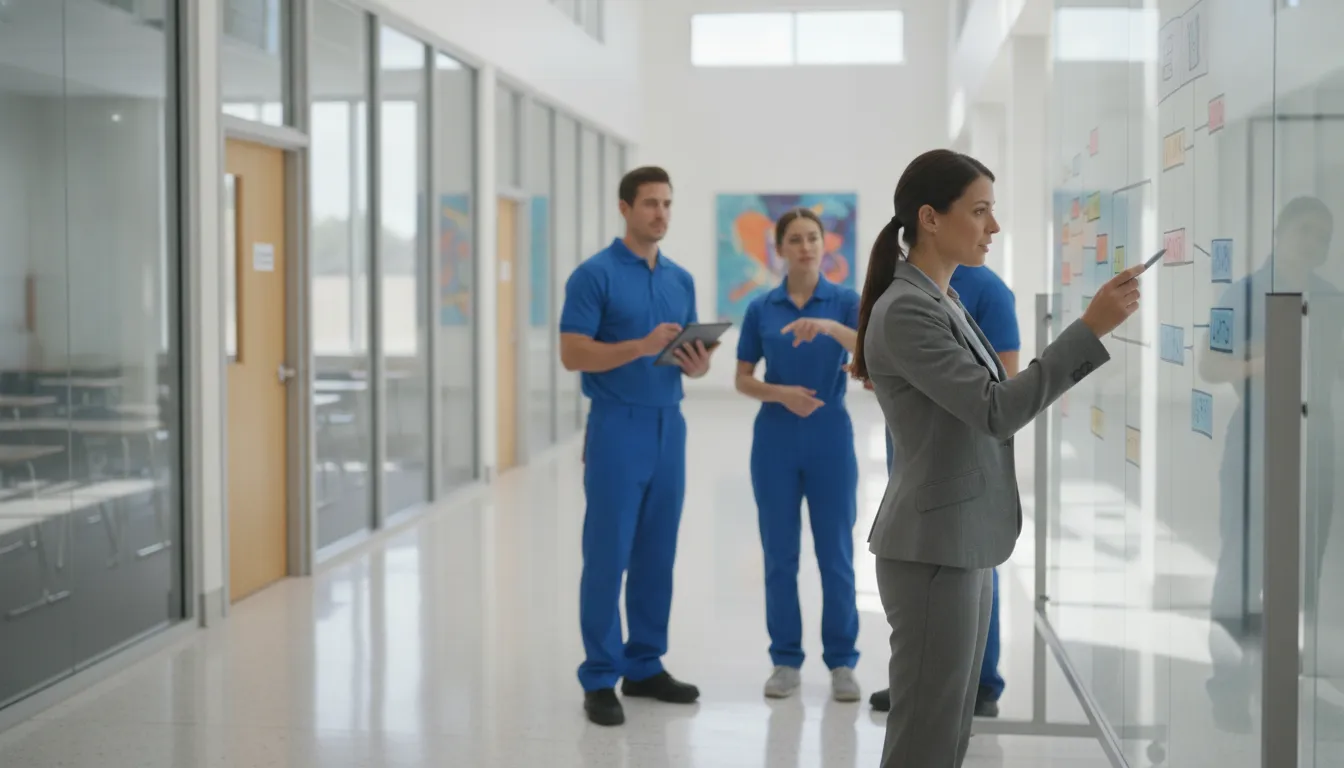
A school cleaning quote should reflect how the campus operates, not a generic rate applied to a square-foot total. Classrooms, restrooms, cafeterias, gyms, laboratories, libraries, and technology areas can require different tasks, frequencies, schedules, and controls.
Request a tailored school cleaning quote
School cleaning services prices are usually shaped by campus size, layout complexity, room types, restroom count, traffic patterns, service frequency, compliance needs, and any specialized equipment or protocols. Foreman Pro Cleaning develops pricing through a walkthrough, needs assessment, customized plan, written scope of work, and tailored proposal rather than publishing a fixed school rate. School and campus cleaning services can also include floor care and day or night porter coverage.
The most useful way to evaluate a quote is to understand what each provider has included. How often each area will be serviced, and how the plan fits the academic calendar. That starts with examining the specific elements that determine the scope.
How Are School Cleaning Services Prices Usually Determined?
School cleaning services prices are determined by the actual scope of work, not by a universal rate that applies to every campus. A compact school with a simple layout has different operational requirements than a multi-building campus. Classrooms, cafeterias, bathrooms, gymnasiums, laboratories, libraries, and technology facilities may all be included. Foreman Pro Cleaning evaluates those differences before developing a proposal, and its school and campus programs are customized according to campus size and service requirements. Learn more about school and campus cleaning services.
Campus size and layout. Square footage is an important starting point, but it does not describe the full work environment. A quote may change based on the number of buildings, floors, entrances, corridors, stairwells, and separated service zones. Layout complexity can affect travel time, equipment movement, access procedures, and how tasks are assigned across the campus. Restroom count also matters because these areas require defined cleaning frequencies, replenishment expectations, and inspection standards.
Traffic patterns and environment type. A school does not experience the same level of use in every room. Entryways, corridors, cafeterias, bathrooms, gyms, and shared learning areas may require more attention than lower-traffic administrative spaces. The Centers for Disease Control and Prevention recommends considering both surface type and touch frequency when deciding what cleaning is needed. Its guidance also notes that high-traffic areas may warrant more frequent cleaning or disinfection. Review CDC cleaning guidance for facilities.
Frequency, compliance, and specialized protocols. Daily custodial coverage, periodic floor services, event support, daytime porter coverage, and academic-calendar scheduling can produce different scopes. Requirements may also vary for food-service areas, bathrooms, laboratories, technology facilities, or other environments with specialized procedures. CDC guidance directs schools to follow facility-specific regulations and local policies for disinfection procedures in areas such as food services and bathrooms. See CDC guidance for cleaning and disinfection in schools.
Foreman Pro’s process is designed to make those assumptions visible. A consultation and walkthrough support a needs assessment, followed by a custom cleaning plan, written Scope of Work, and tailored proposal. The written scope should identify the spaces covered, tasks, frequencies, schedules, and any floor-care or specialized services. That detail gives school leaders a practical basis for comparing proposals and confirming that the requested coverage matches campus operations.
Which Campus Areas and Surfaces Change the Scope?
A school campus is not one uniform cleaning environment. Classrooms, cafeterias, bathrooms, gymnasiums, dormitories, laboratories, libraries, and technology facilities each create different requirements for labor, equipment, documentation, and quality control. Foreman Pro Cleaning identifies these spaces as part of the potential educational-facility scope. A useful proposal should therefore describe the actual buildings and zones rather than rely on square footage alone (school and campus cleaning services).
How do different campus zones affect the work?
- Classrooms and libraries: Desks, tables, doors, computer keyboards, and other frequently touched items may require regular attention. The CDC recommends considering both surface type and touch frequency when deciding what cleaning is needed (CDC facility cleaning guidance).
- Cafeterias and bathrooms: Food-service areas and restrooms bring distinct sanitation and disinfection considerations. The CDC advises schools to follow applicable local policies or regulations for procedures in these spaces (CDC school preparedness guidance).
- Gymnasiums and dormitories: High-use areas, shared fixtures, and larger occupancy patterns can change the frequency and sequencing of service. High-traffic areas may warrant more frequent cleaning or disinfection, according to the CDC (CDC facility cleaning guidance).
- Labs and technology facilities: These areas may require site-specific access controls, approved procedures, specialized equipment, or additional coordination. Their inclusion should be stated clearly in the written scope instead of being assumed as part of routine classroom service.
Why do flooring and entryways matter?
Surface mix changes the practical work plan. Carpeted classrooms and offices may require scheduled vacuuming and periodic commercial carpet care. While resilient or hard floors may require different dust control, damp cleaning, finish care, or restorative work. Entryways also deserve separate attention because exterior pollutants can be tracked inside. The EPA school indoor-air-quality checklist addresses flooring materials, including carpet and resilient flooring. It also covers entry mat barriers intended to help prevent pollutants from entering the building (EPA school IAQ action checklists).
These differences are central to evaluating school cleaning services prices. A campus with multiple floor types, specialized rooms, extensive restrooms. And high-traffic entry points will need a more detailed scope than a single-building facility with a consistent surface mix. Foreman Pro’s commercial pricing factors include square footage, layout complexity, restroom count, traffic patterns, service frequency, environment type, compliance needs, and specialized protocols (commercial cleaning pricing factors). During a walkthrough, identify each zone, surface type, access condition, and required task so the proposal reflects the campus you actually operate.
How Do Frequency, Occupancy, and Scheduling Affect a Quote?
Frequency is one of the clearest reasons school cleaning services prices vary from one campus to another. A school that needs a defined nightly reset has a different service plan from a campus that needs daytime support. Rapid response in high-traffic areas, and additional work around assemblies, athletics, or enrollment events. Occupancy, traffic patterns, surface touch frequency, and the academic calendar should all be translated into a written scope rather than treated as assumptions. Foreman Pro Cleaning uses these operating details to build a plan around the facility’s actual requirements.
- Map daily high-touch care. Identify the surfaces and objects students, faculty, visitors, and support staff use repeatedly. Desks, countertops, doorknobs, computer keyboards, hands-on learning items, faucet handles, phones, and toys are examples the CDC describes as typically receiving daily cleaning and sanitizing in schools. CDC school infection-prevention guidance also makes clear that cleaning routines should account for shared objects and close contact. Include these touchpoints in the recurring scope, then distinguish routine cleaning from sanitizing or disinfecting requirements.
- Adjust the plan for occupancy and traffic. A classroom wing, cafeteria, bathroom group, gymnasium, library, or technology area may experience very different use throughout the day. The CDC recommends considering both surface type and how often a surface is touched, and notes that high-traffic areas may warrant more frequent cleaning or disinfection. CDC facility-cleaning guidance supports using traffic and touch frequency as planning inputs. A quote should therefore identify busy zones, transition periods, entrances, shared equipment, and areas that need additional attention instead of applying one frequency to every room.
- Choose daytime, nighttime, or blended porter coverage. Daytime porter service can support visible, responsive care while a campus is occupied, including attention to restrooms, common areas, spills, and high-use transitions. Nighttime service may be better suited to a more complete after-hours reset. Some schools need both: daytime coverage for active operations and nighttime cleaning for classrooms, floors, and other scheduled tasks. Foreman Pro’s school service scope includes day or night porter programs. So the quote should state coverage windows, response expectations, access limitations, and which tasks occur in each shift. See the company’s school and campus cleaning services information for how these programs can be tailored.
- Coordinate service with the school-year calendar. Build the schedule around instructional days, holidays, breaks, summer use, testing periods, professional-development days, athletic seasons, and special events. Academic-calendar timing can change both access and the type of work needed. A school may require routine occupied-building service during the term. Deeper floor or specialty work during a break, and a modified plan when portions of the campus are closed. Foreman Pro identifies academic-calendar coordination and day or night porter options as part of school scheduling. This school-year cleaning schedule resource can help organize those decisions before a walkthrough.
- Document the frequencies and exceptions in the proposal. Ask for each zone, task, frequency, schedule, and seasonal or specialized service to appear in the written scope. This makes the relationship between operating conditions and school cleaning services prices easier to evaluate. Foreman Pro recommends a walkthrough and a scope that clearly specifies spaces, frequencies, tasks, schedules, and additional floor or specialized services. Commercial cleaning RFP questions can help facilities teams identify what belongs in that documentation before comparing proposals.
What Specialized Services and Compliance Needs Should Schools Plan For?
A school cleaning scope should account for more than routine custodial tasks. Classrooms, cafeterias, bathrooms, gymnasiums, laboratories, libraries, and technology facilities can have different surfaces, exposure concerns, access requirements, and response protocols. Those differences can affect the service plan behind school cleaning services prices, even when two campuses have similar square footage.
How should schools distinguish cleaning, sanitizing, and disinfecting?
These terms describe different outcomes and should not be treated as interchangeable. According to the CDC’s facility guidance, cleaning removes most types of harmful germs from surfaces. Sanitizing reduces the germs remaining after cleaning, while disinfecting can kill harmful germs that remain after cleaning. The sequence matters: surfaces should be cleaned before sanitizing or disinfecting because impurities can interfere with chemical effectiveness.
A written school plan should identify which surfaces receive routine cleaning, which high-touch areas require regular sanitizing, and when disinfection is appropriate. The CDC notes that high-traffic areas may need more frequent cleaning or disinfection, and that surfaces should be disinfected where people have obviously been ill. Some germs may also require specialized cleaning and disinfection rather than a standard routine.
What protocols apply to cafeterias, bathrooms, and body-fluid incidents?
Food-service areas and bathrooms may require procedures that differ from classrooms or administrative offices. Schools should confirm the applicable district, state, local, and facility policies rather than assuming a general commercial protocol covers every area. The CDC recommends consulting local policies or regulations for disinfection procedures in areas such as food services and bathrooms.
Visible blood or other body-fluid contamination also calls for a defined response. CDC guidance says to clean these surfaces and objects immediately and use gloves and other personal protective equipment as warranted. A proposal should clarify who responds, what PPE and chemical procedures apply, how access is controlled, and what documentation follows the incident. These requirements are operational and safety considerations, not assumptions that should be left out of the scope.
Which floor, chemical, and environmental controls should be included?
Floor care may require separate periodic services for carpet, resilient flooring, entry areas, or other surfaces. The EPA’s school indoor-air-quality checklist includes flooring, carpet, entry mat barriers, and operations and maintenance among the areas schools should consider. Chemical selection, storage, dilution, labeling, ventilation, and staff training should align with the school’s safety program and applicable requirements.
Foreman Pro Cleaning can evaluate these needs during a walkthrough and translate them into a custom plan, written scope, and tailored proposal. Its school and campus cleaning services may include campus-wide cleaning, floor services, and day or night porter coverage. The clearer the school is about specialized areas, compliance protocols, floor inventory, and documentation expectations, the more useful the resulting proposal will be.
How Can Schools Compare Cleaning Proposals Without Comparing Price Alone?
A useful proposal makes each vendor’s promised service understandable before a school evaluates the amount on the last line. Foreman Pro Cleaning recommends requesting a walkthrough and a written scope that identifies the spaces. Frequencies, tasks, schedules, and any additional floor or specialized services included in the program. Commercial cleaning RFP questions can help procurement teams structure that review.
| Proposal area | What to verify | Why it matters |
|---|---|---|
| Scope clarity | Named buildings, rooms, surfaces, tasks, exclusions, and service boundaries | Prevents two proposals from appearing comparable when they cover different work. |
| Frequency | Daily, periodic, seasonal, and event-driven tasks, including high-touch areas | Connects the program to occupancy, traffic, and the school’s operating needs. |
| Schedule coverage | Day or night service, academic-calendar coordination, response windows, and porter coverage | Shows whether work can occur without disrupting instruction, activities, or events. |
| Floor care | Routine maintenance and periodic carpet or hard-floor services, listed separately | Clarifies whether long-term floor maintenance is included or treated as an add-on. |
| Special areas | Bathrooms, cafeterias, gyms, labs, libraries, technology areas, and other zones | Confirms that higher-use or specialized spaces have an appropriate plan. |
| Documentation | Inspection methods, service records, issue reporting, escalation, and quality-control reporting | Gives facilities staff a way to verify performance rather than relying on general assurances. |
| Change process | How schedule, occupancy, events, rooms, or service requirements are assessed and approved | Reduces confusion when the campus changes during the school year. |
The lowest number may not represent the same service. One proposal might include only routine classroom cleaning, while another accounts for restrooms, cafeterias, gymnasiums, laboratories, technology facilities, floor care, and daytime coverage. Foreman Pro’s school programs can include campus-wide cleaning, custodial and janitorial services, floor services, and day or night porter programs. Those elements should be identified rather than assumed. School and campus cleaning services can be organized around the facility’s actual mix of spaces.
Frequency also deserves close review. The CDC describes regular attention to frequently touched surfaces as part of routine school cleaning and notes that high-traffic areas may warrant more frequent cleaning or disinfection. Schools should use facility conditions and applicable policies to determine the appropriate approach, rather than treating every room as equivalent.
APPA service-level concepts may offer neutral vocabulary for discussing expected appearance and custodial coverage, but they should not be treated as a universal price schedule. A school should compare each proposal against its own written requirements, then ask vendors to explain any difference in frequency, staffing, documentation, floor care, or special-area coverage. That process produces a more meaningful comparison of school cleaning services prices because it evaluates the service being purchased, not just the number attached to it.
What Should a School Include Before Requesting a Quote?
The more clearly a school describes its operating environment, the more useful its cleaning proposal will be. A facilities director does not need to predict the final scope alone, but gathering the right information before a walkthrough helps the provider evaluate the campus accurately. It also helps the school compare school cleaning services prices based on equivalent expectations rather than incomplete assumptions.
- Identify the campus footprint. Provide available square-footage information, building names, floor counts, entrances, and any separate athletic, residential, administrative, or support facilities. A map or basic site plan can help identify travel paths and service zones.
- List the rooms and priority areas. Note classrooms, cafeterias, bathrooms, gyms, libraries, laboratories, technology areas, offices, corridors, stairwells, storage spaces, and high-traffic entrances. Include spaces that may be used seasonally or after normal school hours.
- Describe occupancy and traffic. Explain student and staff patterns, arrival and dismissal periods, lunch rotations, athletics, assemblies, public events, and areas with frequent shared contact. This information helps separate routine care from zones that need more frequent attention.
- Share the academic calendar and access windows. Identify instructional days, breaks, testing periods, summer programs, professional-development days, and event dates. State whether daytime, nighttime, or blended porter coverage is preferred, along with security, badge, escort, or alarm requirements.
- Inventory floors and specialized surfaces. Record carpet, resilient flooring, hard floors, mats, stairs, and other surfaces. Ask that routine maintenance, commercial carpet cleaning, restorative floor work, and seasonal services be identified separately in the proposal.
- Document compliance and response requirements. Flag food-service areas, bathrooms, laboratories, technology facilities, body-fluid response expectations, PPE procedures, approved products, reporting needs, and any district or local requirements. General guidance should not replace facility-specific policies.
- Ask for a written scope and change process. The proposal should name included spaces, tasks, frequencies, schedules, exclusions, documentation, quality checks, and any add-on services. Ask how schedule changes, construction, new rooms, events, or occupancy changes will be assessed and approved.
Foreman Pro Cleaning’s quote process includes a consultation and walkthrough, needs assessment, custom cleaning plan, written Scope of Work, and tailored proposal. That structure gives school leaders a practical way to move from a broad request to a service plan tied to the actual campus.
Contact Foreman Pro Cleaning to discuss your school or campus cleaning needs
Frequently Asked Questions
What affects school cleaning services prices?
School cleaning services prices depend on the campus size and service requirements, not on a universal school rate. A proposal may account for layout complexity, restroom count, traffic patterns, service frequency, environment type, compliance needs, and specialized equipment or protocols. Classrooms, cafeterias, bathrooms, gymnasiums, laboratories, libraries, and technology areas can each require different tasks and frequencies. Foreman Pro Cleaning evaluates those conditions when developing a tailored program.
Is square footage enough to estimate a school cleaning quote?
No. Square footage is useful for planning, but it does not describe how a school operates. Two buildings with similar footprints may have different restroom counts, floor surfaces, occupancy patterns, high-traffic zones, academic schedules, and specialized areas. A reliable assessment should also consider the services required, such as routine custodial work, floor care, or daytime and nighttime porter coverage.
What should a school cleaning proposal include?
Request a written scope that identifies the spaces covered, cleaning frequencies, specific tasks, service schedules, and any additional floor or specialized services. It should also clarify access expectations, communication, quality-control documentation, and how scope changes will be handled. This level of detail makes proposals easier to compare than a single total without defined deliverables. Foreman Pro’s proposal process includes a needs assessment, custom cleaning plan, written Scope of Work, and tailored proposal.
How can a school request a cleaning walkthrough?
Contact a qualified provider and request a consultation and on-site walkthrough. Have a campus map or square-footage information, room list, floor inventory, academic calendar, preferred service windows, and known compliance or access requirements available. During the walkthrough, discuss high-traffic areas, restrooms, cafeterias, gyms, laboratories, and technology spaces so the provider can build a scope around actual conditions. Foreman Pro coordinates school programs with academic calendars and can develop a customized plan after assessing the facility.
Are You Ready to Request a School Cleaning Quote?
A useful school cleaning proposal begins with an accurate understanding of your campus, operating schedule, priority areas, and service expectations. Foreman Pro Cleaning can use that information to develop a customized plan and written scope for your school or campus.
