
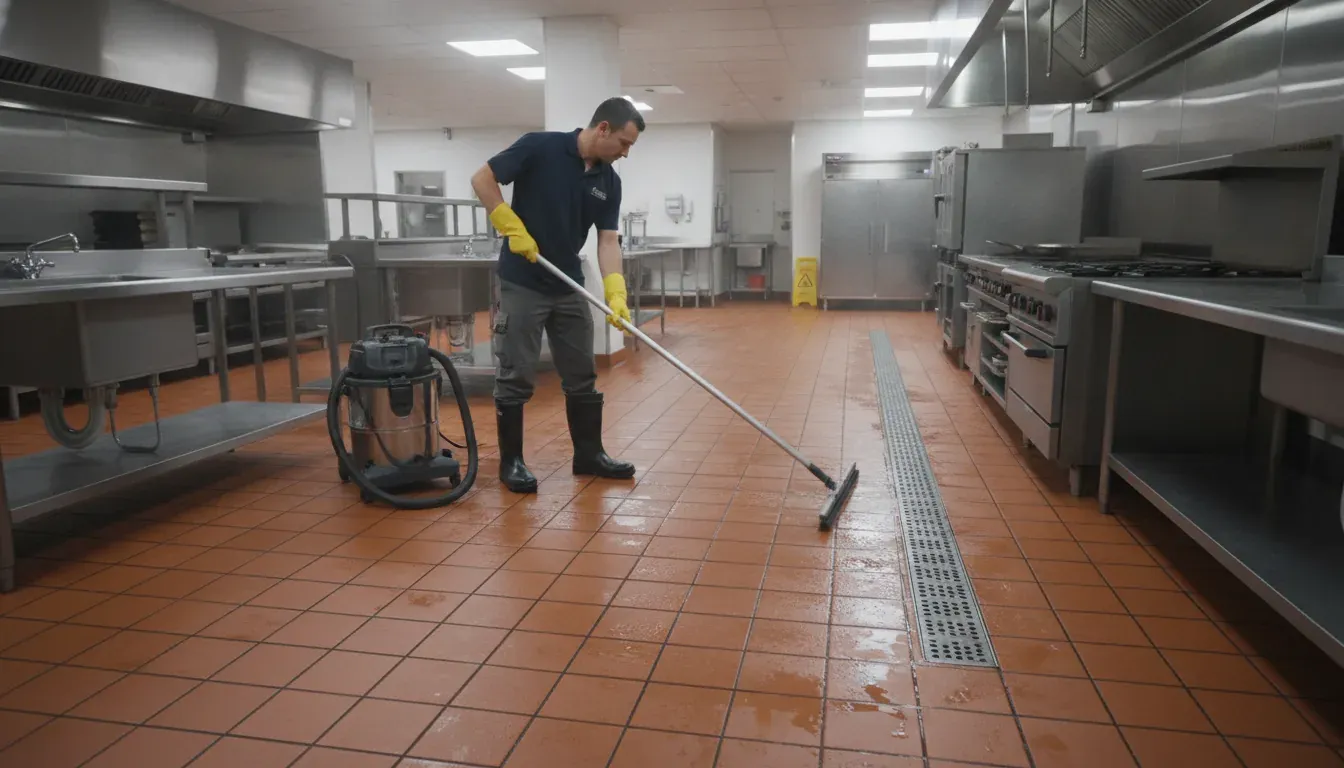
A kitchen floor can shift from dry and clear to slick or obstructed as work moves between prep, cooking, washing, and deliveries. For facility leaders, that makes floor care an operational control, not a cosmetic task.
Effective commercial kitchen floor cleaning depends on a facility-specific plan that accounts for the floor surface, changing soil and moisture, drainage, and the need to inspect conditions during service. Follow applicable food-safety and workplace requirements, plus product and flooring guidance, when setting procedures; a single method is not right for every kitchen.
Discuss a tailored commercial floor-care plan with Foreman Pro Cleaning
Understanding how floor conditions affect both worker safety and sanitation is the first step toward setting priorities that fit the facility and its daily operations.
Why Does Commercial Kitchen Floor Cleaning Matter for Safety and Sanitation?
A kitchen floor is part of the work environment, not a food-contact surface. But its condition can affect safe movement and the control of soil and moisture around active work areas. Grease, food residue, and liquids can create slippery or difficult-to-inspect areas. Routine attention helps staff identify changing conditions and respond before a localized issue becomes a broader operational concern.
Floor care also supports a facility’s wider sanitation controls. Residue can collect in joints, edges, and beneath equipment, while tracked soil may spread between work zones. Cleaning alone does not establish that a food-service operation meets every sanitation requirement; facilities need procedures that account for their layout, equipment, floor materials, and applicable rules.
How does the Food Code fit into local requirements?
The U.S. Food and Drug Administration describes its Food Code as a model for safeguarding public health and ensuring food offered to consumers is safe and honestly presented. It is offered for adoption by government jurisdictions with food-service compliance responsibilities, so it should not be treated as a single, automatically binding national rule. The FDA Food Code provides a useful reference, but facilities should verify the requirements adopted by the authority that oversees their operation.
That distinction matters across Maryland, Washington, D.C., and Virginia. NIOSH notes that food-preparation and service regulations are issued by state health departments and vary from state to state. It advises facilities to consult their own state health department. Its food-service checklist applies broadly to operations preparing or serving food to the public, but it does not replace current local requirements. Check the NIOSH food-service checklist and jurisdiction guidance alongside the applicable state or local rules.
Why should floor condition receive regular attention?
Floor condition can change between scheduled services as spills, traffic, and moisture accumulate. A manufacturer guide for its quarry tile warns that improper maintenance can affect appearance, durability, and slip resistance. That guidance is specific to the tile discussed, not a universal performance claim for every surface. Review the manufacturer’s quarry-tile maintenance guidance where that material is installed, and follow the actual floor manufacturer’s instructions for other surfaces.
For facility teams, prudent oversight means including floor condition in routine observation and acting on visible hazards through the site’s established procedures. Confirm that maintenance practices align with local food-service requirements and surface guidance. These controls help make floor care part of both workplace safety and sanitation, without assuming that one method or schedule fits every kitchen.
How Should Teams Control Grease, Spills, and Routine Soil?
Kitchen floors face two different demands: a spill or grease deposit can need attention between scheduled services, while crumbs and tracked-in soil accumulate through normal operations. A practical plan accounts for both. Staff should follow the facility’s approved response process when a spill occurs, while the regular floor-care schedule should reflect the kitchen’s layout, traffic, work patterns, and floor material.
Spot response is not a substitute for routine cleaning. Virginia’s retail food establishment rule addresses spills or drippage occurring between normal floor-cleaning times and describes spot-cleaning options for liquid spills. That provision is specific to Virginia and should not be treated as a universal procedure; facilities elsewhere should confirm the requirements that apply in their jurisdiction. Virginia’s rule
For immediate operational decisions, teams should use their established safety and food-service procedures, including any steps for controlling access to a wet or greasy area. The relevant floor-care instructions also depend on the surface. For example, a manufacturer advises immediate spill cleanup for the epoxy and stained-concrete floors covered in its guidance. That is product-specific advice, not a universal specification or a Foreman Pro protocol. The manufacturer’s floor-maintenance guidance
How should routine cleaning account for soil?
Routine work should address dry debris as well as residue left by daily activity. A commercial-floor guide recommends establishing a sweeping, vacuuming, and mopping routine to limit debris buildup, but the right tasks and timing depend on site conditions. The same calendar may not suit a low-traffic prep area and a high-traffic route near cooking or warewashing. Instead of assigning an unsupported universal frequency, map the work to where soil collects, when the floor is accessible, and what the surface manufacturer permits.
Manufacturer guidance illustrates why a facility-specific schedule matters: for the quarry tile discussed in its guide, the manufacturer recommends daily sweeping and damp mopping, with additional periodic care. Those instructions apply to that tile guidance only; they should not be transferred automatically to another floor. Commercial floor-care guidance
Documenting recurring spill locations, soil patterns, and response needs can help managers adjust coverage as operations change. Foreman Pro Cleaning offers customized commercial floor-care planning, but its available service information does not establish kitchen-specific sanitation procedures. Facilities should set their own approved response protocols and applicable service intervals. For broader planning considerations, see these commercial floor maintenance practices.
How Does Commercial Kitchen Floor Cleaning Address Drainage and Drying?
Water left on a walking surface can combine with grease or food residue to create a slip hazard. Drainage and drying belong in the facility’s floor-safety plan, alongside cleaning and inspection. OSHA’s general-industry walking-working-surface rule requires workroom floors to be clean and, to the extent feasible, dry. Where wet processes are used, it calls for drainage and, where feasible, dry standing places such as platforms or mats. It also requires inspection and correction or repair of hazardous conditions before employees use the area again (OSHA 29 CFR 1910.22).
Those requirements set a useful framework, but they do not prescribe one drain layout or drying method for every kitchen. The facility should account for its equipment, floor design, workflow, and applicable local food-service requirements when developing written response steps. The plan should identify who checks wet areas, how a hazard is isolated, how water is managed safely, and who confirms the area is suitable for use again. These are planning considerations, not a substitute for the facility’s own risk assessment or regulatory review.
What should a drainage check cover?
A NIOSH food-service self-inspection checklist asks whether equipment drain lines discharge properly and without flooding. Use that as a clear inspection prompt: observe discharge during relevant operations. Look for overflow or water spreading onto walking routes, and report a blocked or damaged line through the facility’s maintenance process. The checklist is a reference point, not proof that a particular kitchen meets every applicable requirement. NIOSH also advises checking the food-service rules that apply in the facility’s state.
NIOSH food-service checklist: drain-line discharge | NIOSH guidance on state requirements
How can teams close out a wet-area response?
Before reopening a temporarily restricted area, a designated person can verify that the source of water has been addressed. The walking surface is no longer visibly wet, and no new pooling or discharge issue is present. Keep people away from an active hazard while the response is underway, using the facility’s approved controls. Record the observation, action taken, and any follow-up maintenance needed so recurring drainage problems are visible to supervisors. A service log or inspection record supports accountability, but it does not guarantee that slips will be prevented. Foreman Pro’s documented operations include supervisor inspections and digital service logging; kitchen-specific response procedures should be established by the facility.
Which Floor-Care Method Fits Each Kitchen Surface?
A floor label is not enough to select a cleaning method. Quarry tile, ceramic tile, epoxy, and sealed or stained concrete can differ in texture, grout, coating, age, and condition. Those details affect what the installed system can tolerate. Virginia’s food-establishment rule calls for surfaces in food-operation areas to be smooth, durable, and easily cleanable. And nonabsorbent where exposed to moisture; the rule is jurisdiction-specific, so facilities should verify the requirements that apply to their location. Virginia regulation
The examples below summarize manufacturer guidance for the named materials, not universal cleaning instructions and not Foreman Pro protocols. They are a starting point for questions, not a substitute for identifying the installed finish. Confirm the exact floor product, any sealer or coating, and its condition, then consult the applicable manufacturer instructions before choosing equipment, chemistry, or process.
| Surface | Documented source-specific concern | Planning implication |
|---|---|---|
| Quarry or ceramic tile | Metropolitan Ceramics warns that improper maintenance can affect the appearance, durability, and slip resistance of its tile. Its guide describes recommendations for its quarry tile specifically. Manufacturer guidance | Identify tile type and condition, including grout and any treatment, and check the installed product’s instructions. Do not assume a method recommended for one manufacturer’s quarry tile also applies to ceramic tile or another product. |
| Epoxy | The cited manufacturer guidance says grit can scratch epoxy and cautions that soap-based cleaners may leave a film. Manufacturer guidance | Confirm the coating system and its maintenance requirements. Include surface condition and residue concerns in method selection rather than transferring tile guidance directly to epoxy. |
| Stained or sealed concrete | The same guide cautions that harsh products can break down or remove the sealer, and that grit may scratch stained concrete. These points concern the guide’s stated surface context. Manufacturer guidance | Verify whether the concrete is stained, sealed, or otherwise treated, and identify the sealer before selecting a process. The finish, not just the concrete base, matters to compatibility. |
These distinctions matter because a method that seems suitable for one hard floor may leave residue or affect another floor’s finish. Manufacturer documentation is the appropriate reference for product-specific limitations; facility procedures and applicable food-service requirements also govern the work. If the surface identity or coating is uncertain, resolve that uncertainty before specifying a routine. Document the confirmed material and approved instructions so scheduling and service planning do not depend on guesswork.
How Can Facilities Schedule, Inspect, and Document Floor Care?
A workable floor-care calendar reflects how each area is used, not a one-size-fits-all interval. Map traffic patterns, production periods, spill-prone zones, floor materials, and access constraints with the facility’s operations and food-safety leads. Separate recurring work from prompt response to spills, and review the schedule when use, equipment, or surface condition changes. Food-service requirements vary by state, so confirm applicable rules with the relevant health authority rather than assuming one checklist fits every location (NIOSH food-service checklist).
Schedule disruptive work for an approved low-activity window when feasible. Foreman Pro’s commercial programs can accommodate after-hours, overnight, early-morning, weekend, or recurring schedules, with frequency tailored to facility use. That is a general service capability, not a claim of kitchen-specific certification or sanitation procedures. Facilities evaluating outside support can review commercial floor care services and commercial hard-floor cleaning.
Discuss a tailored floor-care plan with Foreman Pro.
Before service, a facility’s approved checklist can record the area, visible surface condition, known hazards, access restrictions, and any site-specific requirements for the assigned team. After service, document the work window, areas completed, condition observed, and any exception requiring follow-up. These are planning prompts for the facility to adapt, not a prescribed Foreman Pro kitchen SOP. Keep food-contact sanitation decisions and product requirements under the site’s applicable procedures and authority.
Supervisors can inspect against clear, observable criteria: whether assigned areas were addressed. Whether the floor is ready for the next operation, and whether damage, standing water, or unresolved hazards need escalation. A dated inspection record supports follow-up; NIOSH’s checklist itself includes an inspection-date field, while its guidance directs operators to consult the applicable state requirements. Do not assume its sample retention period applies outside its stated context.
Digital logs make recurring exceptions easier to spot. Record the location, issue, action owner, and closure status, then use the pattern to adjust timing or request maintenance. Foreman Pro documents capabilities such as supervisor inspections, technology-driven checklists, digital service logs, and monthly client performance summaries; any scope should be confirmed for the specific facility. For broader commercial floor maintenance practices, align the plan with the surface manufacturer and site requirements.
Contact Foreman Pro to discuss scheduling and documentation needs.
Frequently Asked Questions
How do I choose a cleaner for a kitchen floor?
Start with the exact flooring material, finish or sealer, and its manufacturer care instructions. Then verify that the proposed cleaner is compatible with that surface and the facility’s applicable food-service requirements. Guidance for a specific quarry tile or epoxy system is not universal advice. Flooring manufacturer maintenance guidance illustrates why product and surface instructions matter.
Do commercial kitchen floor rules differ by state?
Yes. The FDA Food Code is a model offered for adoption, while food-service regulations vary by state. Confirm the rules adopted by state and local authorities for your facility rather than applying requirements from another jurisdiction. FDA Food Code; NIOSH food-service checklist.
How often should a commercial kitchen floor be cleaned?
There is no single schedule for every kitchen. Set routine service around surface instructions, facility activity, and applicable rules, with a separate facility-approved response for spills between scheduled cleaning periods. Review the schedule when operations or floor condition changes.
What should I share when scheduling professional floor care?
Identify the floor material and finish, product restrictions, operating hours, high-traffic areas, and applicable site procedures. Discuss how the work can fit the schedule and how completion will be documented. Foreman Pro provides tailored commercial floor-care planning and after-hours scheduling, but the facility’s surface-specific and jurisdictional requirements should guide the scope.
Would a Tailored Floor-Care Plan Help Your Facility?
Commercial kitchen floors call for planning that accounts for the facility’s surfaces, operating hours, and applicable requirements. Foreman Pro Cleaning provides commercial floor-care services and develops customized cleaning plans based on facility needs. The company’s coverage includes Maryland, Washington, D.C., and Virginia. A walkthrough can help clarify the scope, schedule, and documentation priorities for your facility, without assuming one process fits every floor.
Contact Foreman Pro Cleaning to discuss commercial floor-care planning.
