
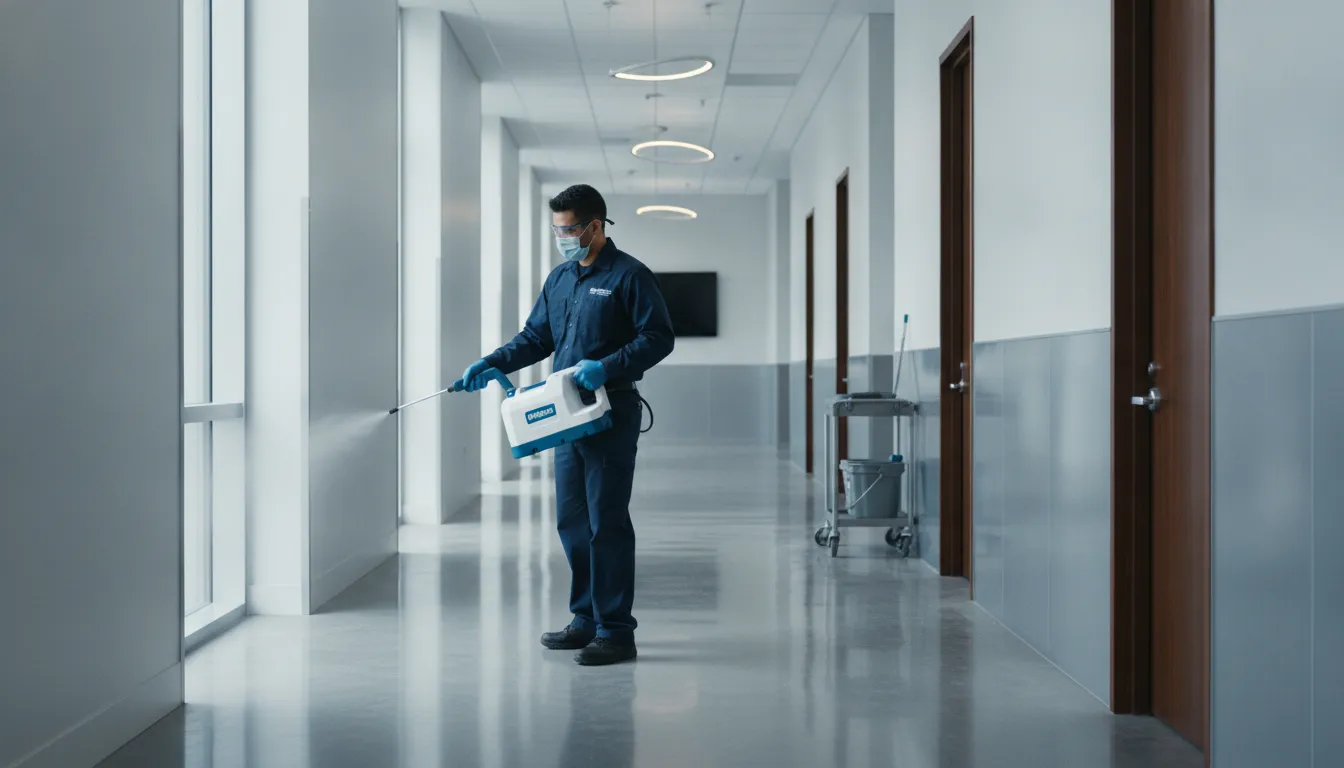
Facility managers rarely receive a responsible electrostatic cleaning quote from a single square-foot figure. The work may involve different treatment zones, surface materials, access conditions, operating schedules, and documentation requirements. The scope must fit the facility rather than a generic rate card.
Request a customized cleaning plan and facility walkthrough.
The commercial electrostatic cleaning cost depends on the area and surfaces being treated, layout complexity, frequency, access or maintenance windows, product requirements, safety controls, and reporting needs. A walkthrough, needs assessment, written scope, and proposal establish what the service requires before pricing is discussed.
Foreman Pro Cleaning also evaluates whether electrostatic application is appropriate for the environment. It supports a broader disinfection protocol and does not replace physical cleaning, label directions, dwell time, ventilation, re-entry, or material-compatibility requirements. Understanding those variables makes the first conversation more productive.
What Does Commercial Electrostatic Cleaning Cost?
There is no universal rate card for commercial electrostatic cleaning cost. The total depends on the facility, treatment area, surfaces, service frequency, access conditions, product requirements, and documentation or environmental control needs. A small office with straightforward access is not scoped the same way as a medical facility, data center, laboratory, or other critical environment.
That makes this a narrower question than general commercial-cleaning pricing. Routine commercial cleaning may be organized around recurring tasks and a regular schedule. Electrostatic disinfection adds method-specific decisions, including which surfaces can be treated and whether the selected disinfectant label permits electrostatic application. It also considers how the area will be prepared and what dwell time and re-entry requirements apply. EPA guidance says a product label must specifically address electrostatic spraying for that application method to be recommended. EPA has not evaluated safety and efficacy for methods absent from the label. Read the EPA guidance on electrostatic spraying.
Foreman Pro Cleaning develops a custom scope rather than offering a cookie-cutter quote. The process can include a consultation, facility walkthrough, pre-inspection, needs assessment, written scope of work, and proposal. That review identifies the treatment zones, surface mix, operational constraints, safety requirements, and reporting expectations before a proposal is prepared. Foreman Pro offers electrostatic spraying with EPA-registered disinfectants whose labels permit electrostatic application as part of its sanitization and disinfection services. Electrostatic application does not replace physical cleaning of visibly soiled surfaces or compliance with the product label.
When comparing proposals, look beyond a headline figure. Confirm what preparation, treatment areas, products, scheduling assumptions, safety controls, re-entry instructions, quality checks, and reporting are included. A clearly defined scope gives your team a more useful basis for evaluating service value and preventing unexpected changes later.
Which Commercial Electrostatic Cleaning Cost Factors Change the Quote?
Square footage is a useful starting point, but it does not describe the work by itself. Two facilities with the same footprint can require very different treatment plans because their rooms, surfaces, traffic, and operating conditions are not the same. Foreman Pro Cleaning evaluates those details during a walkthrough and needs assessment rather than applying a single rate to every building.
How do size and layout affect the scope?
Total area helps establish how much space may need treatment, while the layout determines how technicians move through it. An open office may allow a straightforward route. A building divided into small rooms, corridors, storage areas, treatment zones, and controlled-access spaces can require more planning, repositioning, and documentation. The quote should identify which areas are included, excluded, or treated under a separate protocol.
Square footage can also mislead when only part of a facility needs service. A targeted response may focus on occupied work areas, shared touchpoints, or designated zones instead of the entire building. Conversely, a larger area with complex surfaces or restricted access may require more preparation than its size suggests. Foreman Pro’s commercial cleaning cost factors guide provides broader context for why area should be considered alongside service scope.
What surfaces and rooms require additional consideration?
Surface mix changes the assessment because hard, non-porous surfaces, finished flooring, upholstery, equipment exteriors, and other materials may have different compatibility and application requirements. The plan should account for what can be treated, what must be protected, and what needs another cleaning method. Restroom count matters as well. Restrooms generally involve more fixtures, touchpoints, soil load, and preparation than an equivalent amount of open floor area.
Why do traffic and facility type matter?
Traffic patterns help determine how quickly treated areas may be reoccupied and whether shared entry points, break rooms, elevators, or high-contact routes need special attention. Facility type adds another layer. Offices, medical facilities, schools, retail sites, and fitness centers have different use patterns. Data centers, laboratories, cleanrooms, broadcast studios, and command centers may require controlled entry, ESD-safe methods, low-lint materials, HEPA filtration, specialized protocols, and detailed reporting. Those environmental and compliance requirements can change the scope even when the treated area is modest.
A reliable quote therefore reflects facility conditions, treatment zones, surface mix, access, and the required level of control, not just a number copied from a square-foot calculator.
How Do Preparation and Product Requirements Affect Pricing?
Preparation and product requirements can change the scope of commercial electrostatic cleaning because effective application is a controlled process, not simply a pass with a sprayer. Before treatment, technicians need to identify visibly soiled areas and remove surface contamination through the appropriate cleaning method, consistent with CDC cleaning and disinfection guidance. They also protect or remove sensitive items and define the surfaces included in the work. The condition of the facility, the amount of preparation required, and the documentation expected all belong in the assessment behind a quote.
Why does the product label matter?
The disinfectant must be appropriate for the surface, the intended use, and the application method. The EPA states that a product label must specifically include directions for electrostatic spraying before that method is used. EPA has not evaluated a product’s safety and efficacy for an application method that its label does not address. That requirement can affect product selection, technician procedures, personal protective equipment, and the time needed to review site-specific safety controls.
Electrostatic sprayers charge liquid droplets as they pass through the nozzle. The charged droplets can be attracted to environmental surfaces, which may improve coverage on hard, non-porous surfaces, including some areas outside the direct spray path. This is the operating principle explained in the guide to how electrostatic disinfection works. It does not mean every material or surface should be treated in the same way. Porous materials, electronics, finishes, coatings, and sensitive equipment require a compatibility decision rather than an assumption.
What must be controlled during application?
Product selection is only one part of the protocol. Deposition must be sufficient for the treated surface to remain visibly wet for the product’s required contact time. Applying too little can reduce the concentration reaching the surface or shorten wet contact time, while applying too much can increase residue, exposure, or recovery requirements. EPA’s electrostatic-spraying guidance identifies deposition rate, charge behavior, and loss of active ingredient to the air as variables that can affect performance. The applicable label, not a generic timetable, determines contact time and other directions.
A complete scope should also address ventilation, occupied-area controls, re-entry conditions, and material compatibility according to the selected product label and the facility’s own procedures. In a data center, laboratory, medical facility, or other critical environment, the facility team may specify SOP review, exclusion zones, ESD-safe methods, controlled agents, and written documentation. These are scope questions to confirm with the facility, not universal requirements for every site. Foreman Pro Cleaning evaluates them alongside visible soil removal and the selected disinfection method. Electrostatic application supports a broader cleaning and disinfection protocol; it does not replace physical cleaning, label compliance, ventilation, dwell time, re-entry controls, or a surface-specific safety review.
How Do Frequency, Scheduling, and Access Change the Scope?
A one-time response and a preventive program rarely require the same plan. Outbreak response may call for a defined treatment area, rapid mobilization, and coordination with the facility’s cleaning and re-entry requirements. A preventive program may use a recurring cadence that fits traffic patterns, occupancy, and the surfaces most likely to need attention. Foreman Pro offers electrostatic disinfection for outbreak response, preventive programs, and critical-environment applications. The scope is built around the facility’s operating conditions rather than a generic service interval.
Frequency also changes planning. Commercial schedules may be weekly, several times per week, after-hours, overnight, on weekends, or otherwise customized. More frequent service can require a repeatable route, consistent product and equipment controls, and service records that help facility leaders confirm what was treated. A lower-frequency response scope may instead emphasize mobilization, site orientation, and a clearly defined completion report.
Access can be just as important as square footage. Restricted areas may require advance authorization, escorts, badging, background requirements, or coordination with security personnel. Travel between buildings, controlled elevators, loading procedures, and staging limitations can add planning time even when the treatment area itself is straightforward. Maintenance windows introduce another constraint: technicians must work within an approved period without interfering with personnel, equipment, production, or other vendors. Overnight and weekend work may reduce disruption, but it can require different staffing and coordination.
Critical facilities need an even more deliberate access plan. Data centers, server rooms, laboratories, and command centers may operate continuously, with work divided into zones or scheduled around maintenance windows. Depending on the facility’s SOPs and equipment-protection requirements, the scope may need to address contamination-control entry protocols, low-lint materials, controlled agents, HEPA filtration, ESD-safe methods, static-dissipative solutions, and reporting requirements. These are items to confirm with the facility team, not interchangeable assumptions from ordinary office service. A useful planning reference is the data center cleaning checklist, which helps teams consider operational controls before work begins.
The most reliable proposal states the frequency, service window, access assumptions, travel expectations, preparation responsibilities, exclusion and re-entry steps, and reporting deliverables. That level of definition helps prevent avoidable disruption and makes competing scopes easier to compare.
Request a customized cleaning plan for your facility.
What Should a Transparent Scope Include?
A transparent proposal should let a facility manager see what is being treated, how the work will be performed, and which assumptions affect the result. It should not reduce a technical disinfection program to a single headline number. Use the following checklist when reviewing a scope for commercial electrostatic cleaning.
| Scope element | Questions to ask | Why it matters |
|---|---|---|
| Treatment area | Which rooms, zones, surfaces, and touchpoints are included? | Defines the actual work area and prevents unclear exclusions. |
| Preparation | Who handles visible soil, removing or protecting sensitive items, and staging? | Clarifies labor, safety controls, and readiness before application. |
| Product and method | Does the product label permit electrostatic application, and what surfaces are compatible? | Connects the method to label directions and material safety. |
| Contact and re-entry | What wet contact time, ventilation, and re-entry conditions apply? | Helps coordinate occupancy and follow the product label. |
| Schedule and access | Is service one-time, recurring, after-hours, or within a maintenance window? | Sets staffing, security, travel, and disruption assumptions. |
| Quality control | What inspection, service log, completion report, or documentation is provided? | Gives operations leaders a record of the work performed. |
For a critical environment, add facility-specific controls to the conversation. A data center, laboratory, cleanroom, or command center may need ESD-safe methods, low-lint materials, controlled agents, HEPA filtration, contamination-control entry procedures, and documented approval before service. Those requirements are not optional details to be added after a proposal is accepted. They help determine whether the method is appropriate, how technicians prepare, and how the work fits the facility’s operating plan.
Foreman Pro Cleaning uses a process built around a walkthrough, tailored plan, safety standards, execution, and quality control or reporting. That approach helps align the scope with the facility rather than copying a generic commercial cleaning template. It also gives buyers a practical basis for comparing proposals: compare treatment boundaries, preparation duties, product requirements, access assumptions, service windows, quality checks, and reporting deliverables.
Request a customized cleaning plan and facility walkthrough.
What Questions Do Facility Managers Ask?
Does electrostatic application replace routine cleaning?
No. Surfaces should be cleaned before disinfection, especially when visible soil or residue is present. Electrostatic application is a disinfection method that supports surface coverage; it does not replace physical cleaning, preparation, required wet contact time, ventilation, re-entry controls, or material-compatibility checks. CDC guidance advises cleaning surfaces before disinfecting them.
How is a commercial electrostatic cleaning quote prepared?
A responsible quote follows a consultation, facility walkthrough, pre-inspection, needs assessment, written scope, and proposal. The scope should identify treatment areas, surfaces, preparation, products, access conditions, scheduling, safety controls, and reporting. This assessment-based process is why Foreman Pro Cleaning does not publish a one-size-fits-all rate card.
Is commercial electrostatic cleaning priced only by square footage?
No. Square footage matters, but layout complexity, restroom count, traffic patterns, surface mix, frequency, environment type, access requirements, compliance needs, and specialized protocols can also change the scope. A per-square-foot figure without these details may not describe the actual labor, preparation, or controls required.
Can electrostatic disinfection be used in critical environments?
It can be considered for appropriate critical-environment applications, but the method must fit the facility’s SOPs and equipment-protection requirements. Data centers, laboratories, and similar sites may require ESD-safe methods, controlled agents, low-lint materials, contamination-control entry procedures, and documentation. The treatment plan should be reviewed with the facility team before work begins.
What product requirements affect electrostatic application?
Use only a product whose label specifically includes directions for electrostatic spraying. EPA states that it has not evaluated a product’s safety and efficacy for application methods not addressed on the label. Follow the label for application, contact time, ventilation, and re-entry requirements. EPA guidance supports this label-specific approach.
How Can You Request a Customized Scope?
Commercial electrostatic cleaning cost is best evaluated after the facility, treatment areas, preparation needs, product requirements, schedule, and access conditions are understood. A clear scope also protects your operations team by defining re-entry expectations, safety controls, quality checks, and documentation before work begins.
Foreman Pro Cleaning serves commercial and critical-environment facilities across Maryland, Virginia, and Washington, D.C. The team can discuss your environment, review the intended treatment, and determine whether electrostatic application fits the broader cleaning and disinfection protocol.
