
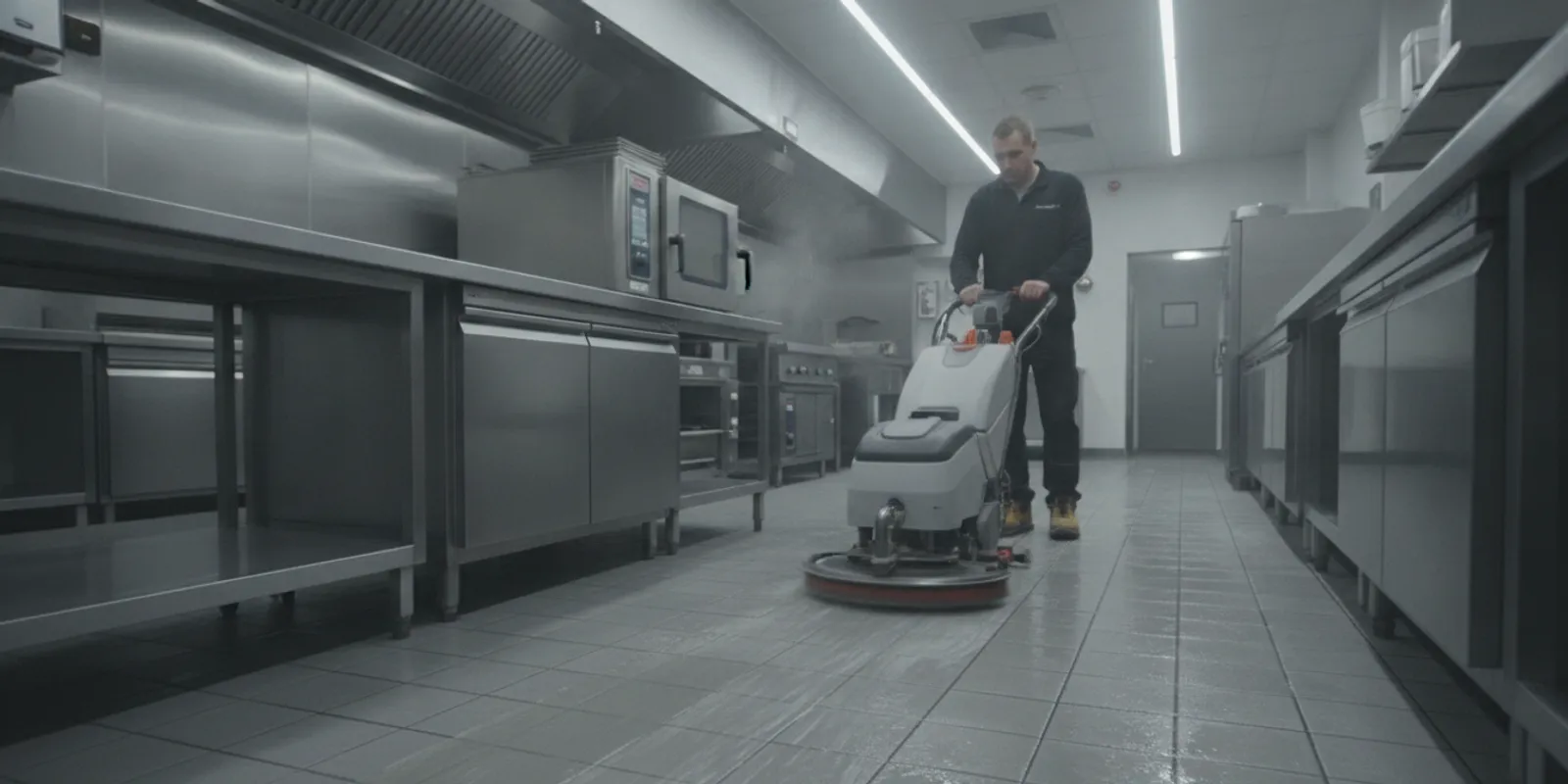
Restaurant kitchen floor cleaning cost depends on the condition and requirements of the floor, not just its square footage. The material, grease and soil buildup, access, work hours, slip-risk controls, and maintenance frequency all affect the labor, equipment, and scheduling a service provider must plan. There is no responsible way to name a rate without assessing those details. This guide shows what to document so you can compare scopes on equal terms.
Request a floor-care assessment
What affects restaurant kitchen floor cleaning cost most?
A quote reflects the work needed to return a floor to an agreed condition and keep it manageable over time. Two kitchens with the same floor area can require different plans. One may have an open layout, compatible flooring, and routine maintenance. Another may have heavy accumulation around cooking lines, narrow clearances, damaged grout, and a short after-hours work window.
For a useful comparison, treat cost as the result of scope. Ask what areas are included, which method is proposed, how often service occurs, what preparation the restaurant must provide, and what limitations apply. A low total that omits the hardest-to-reach zones or needed safety measures may not represent the same service as a more detailed proposal.
How does floor material change the work?
Commercial kitchens may have quarry tile, ceramic tile, textured surfaces, sealed concrete, or other flooring systems. Material and finish influence the cleaning method, tools, solution compatibility, and detail work. For example, grout lines and textured tile can hold residues differently from a smooth, sealed surface. A method that is suitable for one system may be unsuitable for another or may affect a coating.
Before requesting a quote, identify the floor material if known and note any finish, sealant, or previous treatment. If you do not know, share clear photos and ask the provider to verify the surface during a walkthrough. Include transition strips, drains, coved edges, and wall-floor junctions in the assessment; these details can change how much hand work is needed.
How does buildup and condition affect the scope?
A routine maintenance visit is different from corrective cleaning after a long period without thorough service. Grease, food residue, tracked soil, beverage spills, and embedded material can require more passes or more focused work. The condition may vary across the room: a cook line, dishwashing zone, and doorway may need more attention than a low-use storage area.
Describe how the kitchen is used and identify the most affected zones. Note whether residue returns quickly, whether a previous service left a slippery film, and whether any areas are damaged or difficult to reach. A provider should distinguish between cleaning that can address removable buildup and repairs or restoration outside the agreed scope. Do not assume that a single visit can correct worn finishes, failed grout, or other underlying surface problems.
How can restaurant kitchen floor cleaning cost be scoped fairly?
Start with a site-specific scope rather than an assumed per-square-foot rate. Share the approximate cleanable area, a simple floor plan if available, the flooring type, the operating schedule, and the result you need. Then ask each provider to explain the proposed method and service boundaries. A walkthrough helps identify obstacles that measurements alone will miss.
| Cost driver | What to document | Why it can change the scope | Question to ask |
|---|---|---|---|
| Floor type and finish | Material, finish, grout, transitions, drains | Method and tools must suit the surface; edges and joints may need detail work. | How will you confirm the method is compatible? |
| Buildup and condition | Heavy-use areas, residue, prior treatment, visible damage | More intensive or repeated work may be needed, and some defects may fall outside cleaning. | What condition can this scope reasonably address? |
| Area and layout | Approximate floor area, equipment footprint, narrow aisles | Open floor space is different from the same area divided by fixed equipment and tight access. | Which areas are included and excluded? |
| Access and preparation | Equipment that can move, locked areas, water and power access | Limited access can add setup, hand detailing, or coordination time. | What must our team move or secure before service? |
| Schedule and frequency | Available work window, service days, peak operating periods | Restricted hours and one-time recovery work differ from repeatable maintenance visits. | Can the work be divided into phases or recurring visits? |
| Slip-risk controls | Walkway routes, wet-floor separation, drying and reopening plan | Barriers, sequencing, communication, and verification require planning. | How will access be controlled until the floor is ready? |
The table is a comparison framework, not a price list. It deliberately avoids unsupported dollar figures. Its purpose is to make proposals comparable by revealing whether each estimate accounts for the same floor, work, constraints, and outcome.
Which parts of the work should a quote describe?
Ask how the proposed scope is assembled. A provider may need to account for assessment and setup, moving through or around equipment, the selected cleaning process, edge and grout detail, managing the work zone, and the final handoff. Not every facility needs the same steps, and the estimate should explain which are included rather than hiding assumptions in a single total.
Also separate planned work from uncertain conditions. For instance, if access is blocked by movable storage or a floor treatment is not known, ask whether the quote assumes those areas can be reached and how a change will be approved. If the team discovers damage or a condition that requires different work, agree that the provider will explain the issue and obtain authorization before changing the scope. That protects both the operating schedule and the budget from misunderstandings.
Where more than one service frequency is being considered, request options using the same baseline: identical included areas, preparation expectations, and outcome. Then compare the service intervals and any changes in labor or site coordination. This makes a recurring plan easier to evaluate than comparing unrelated totals.
Ask about a commercial floor-care assessment
Why does square footage tell only part of the story?
Area is useful for planning, but it does not describe the shape or accessibility of the work. A kitchen with broad, unobstructed floor sections may be quicker to service than an equal area with tight aisles, fixed appliances, floor sinks, or multiple thresholds. Measurements can also differ depending on whether a proposal counts the full room or only accessible floor surface.
Ask for the area measurement and clarify how it was obtained. Confirm whether storage rooms, walk-in entries, dish areas, and service corridors are included. If staff must move mats, racks, or movable equipment, agree in advance on who will do so and whether those items are part of the work. Avoid comparing bids that use different area definitions.
What access and schedule details should you share?
Commercial kitchens have busy operating periods and fixed equipment that cannot be moved casually. Tell providers when cooking and cleanup end, when the next shift or delivery begins, how staff enter the space, and which doors or corridors must remain available. Explain any site access requirements, alarm procedures, or coordination with a building manager that apply.
A short work window can affect the sequence and number of sections completed at once. If the entire floor cannot be taken out of use together, ask whether the work can be phased while preserving a safe route. Make clear who will provide access and who will communicate when an area is ready to reopen. Foreman Pro Cleaning offers commercial floor-care services; a practical scope should account for the operating needs of the facility, rather than assuming every kitchen can close for the same duration. Learn about commercial floor cleaning services and commercial cleaning programs.
Which slip-risk controls belong in the plan?
Water and cleaning solutions can create temporary slip hazards, especially in a space where employees carry hot items, handle equipment, and move quickly. The plan should address how the active work zone will be separated from staff, how wet areas will be identified, and how the surface will be checked before normal access resumes. OSHA provides workplace safety information at its official website; employers should apply the requirements and procedures relevant to their workplace.
Ask the provider to describe its sequence and the responsibilities on both sides. For example, determine whether kitchen staff need to remove loose items, who will position warning signs or barriers, and how the team will protect adjacent routes. Agree on a clear handoff signal rather than relying on an assumed drying time. Actual drying depends on site conditions, ventilation, temperature, surface, and method, so the plan should be confirmed at the facility.
Also discuss the cleaning method and any solution use with the person responsible for workplace safety. Follow product labeling and site procedures, and keep staff out of restricted areas until the floor is safe for the intended use. A cleaning proposal should not promise an outcome that cannot be verified or override the restaurant’s safety controls.
How does maintenance frequency change the total investment?
One-time restorative work and recurring maintenance solve different problems. A kitchen with established routine cleaning may need a targeted periodic service, while a neglected floor may first need a more intensive reset. After that initial work, repeat visits can help control accumulating residue and may make each visit more predictable. Frequency should follow actual traffic, cooking processes, cleaning responsibilities, and floor condition rather than a generic calendar.
Compare options by total scope over the period you care about. A lower-cost single visit may not include follow-up maintenance. A recurring plan may require a defined service area, agreed access, and a consistent handoff with staff. Ask whether high-use zones can be addressed more often than less-used areas and whether the schedule can be adjusted after the floor’s condition is reviewed.
For context on different floor-care needs, see the guide to office floor stripping and waxing and rubber flooring care considerations. These are not restaurant-specific pricing guides, but they illustrate why the surface and its maintenance needs matter. For a broader discussion of professional floor-care options, match the requested service to the actual kitchen floor rather than selecting a method based only on another facility’s experience.
What should a restaurant compare in cleaning proposals?
Compare the work, not just the headline total. A useful proposal should be clear enough that a manager can tell what the team will clean, what conditions are assumed, and what the restaurant must prepare. It should also describe the method and address access, work timing, and safe return to service.
- Included areas: List the kitchen zones, edges, floor drains, and transitions covered, as well as any exclusions.
- Surface assumptions: Identify the material and finish, or explain what must be verified onsite before work begins.
- Condition and outcome: Record observed buildup and distinguish cleaning expectations from repair or restoration.
- Method: Ask what process and equipment are planned and how they suit the floor and constraints.
- Preparation: Clarify who moves mats, carts, and movable items and how fixed equipment will be handled.
- Safety and handoff: Describe barriers, communication, drying verification, and reopening responsibility.
- Schedule and frequency: Confirm service window, duration assumptions, and whether this is a one-time or recurring scope.
- Changes: Ask how unexpected conditions or inaccessible areas will be handled before additional work is performed.
When you compare two proposals, place them side by side and mark any difference in frequency, included area, preparation, and condition assumptions. Ask providers to clarify gaps in writing. A quote that is easier to audit is also easier to coordinate with kitchen staff and building operations.
To prepare for a walkthrough, gather a rough floor plan, note operating hours, and take photos of the floor in both typical and high-use zones. Mention past treatments or concerns, especially any recurring slickness or finish damage. Foreman Pro Cleaning provides commercial janitorial services and floor-care work across its service region; managers can check service locations and share facility details when requesting a scope.
Discuss your kitchen floor-care needs
Frequently asked questions about restaurant kitchen floor cleaning cost
Can I estimate the cost using only the kitchen’s square footage?
No. Square footage is a helpful starting point, but the floor type, condition, layout, access, schedule, and safety plan also affect the scope. Share the area alongside photos and operating details, then request an onsite review when the layout or condition is complex.
Should I request a one-time deep service or recurring floor care?
That depends on the current condition and how quickly the kitchen floor accumulates residue. A one-time service may address a specific need, while recurring care is intended to maintain an agreed condition. Ask the provider to explain the initial scope separately from any recommended ongoing schedule.
Does every restaurant kitchen floor use the same cleaning method?
No. Methods must account for the material, finish, grout or texture, condition, and site procedures. Identify the floor and ask the provider how it will confirm method compatibility before work begins.
What should I do before the service team arrives?
Confirm what the provider needs moved or secured, arrange access, communicate the work window to staff, and clarify who controls entry to the work zone. Do not assume employees should move fixed appliances or handle tasks outside their role; agree on responsibilities in advance.
How can I compare quotes without published local rates?
Use the same written scope for each request and compare included areas, methods, frequency, access assumptions, safety controls, and exclusions. Ask for clarification when an estimate leaves out a detail instead of treating an unexplained total as directly comparable.
How can you plan the next step?
Document the floor material, approximate area, operating hours, current condition, and any access or slip-risk concerns before asking for an assessment. A clear scope makes it easier to understand what the quote includes, choose a suitable maintenance frequency, and plan service around restaurant operations.
Request a restaurant floor-care consultation
With those details in hand, you can evaluate proposals on a consistent basis and select a plan that fits your kitchen and its daily demands.
