
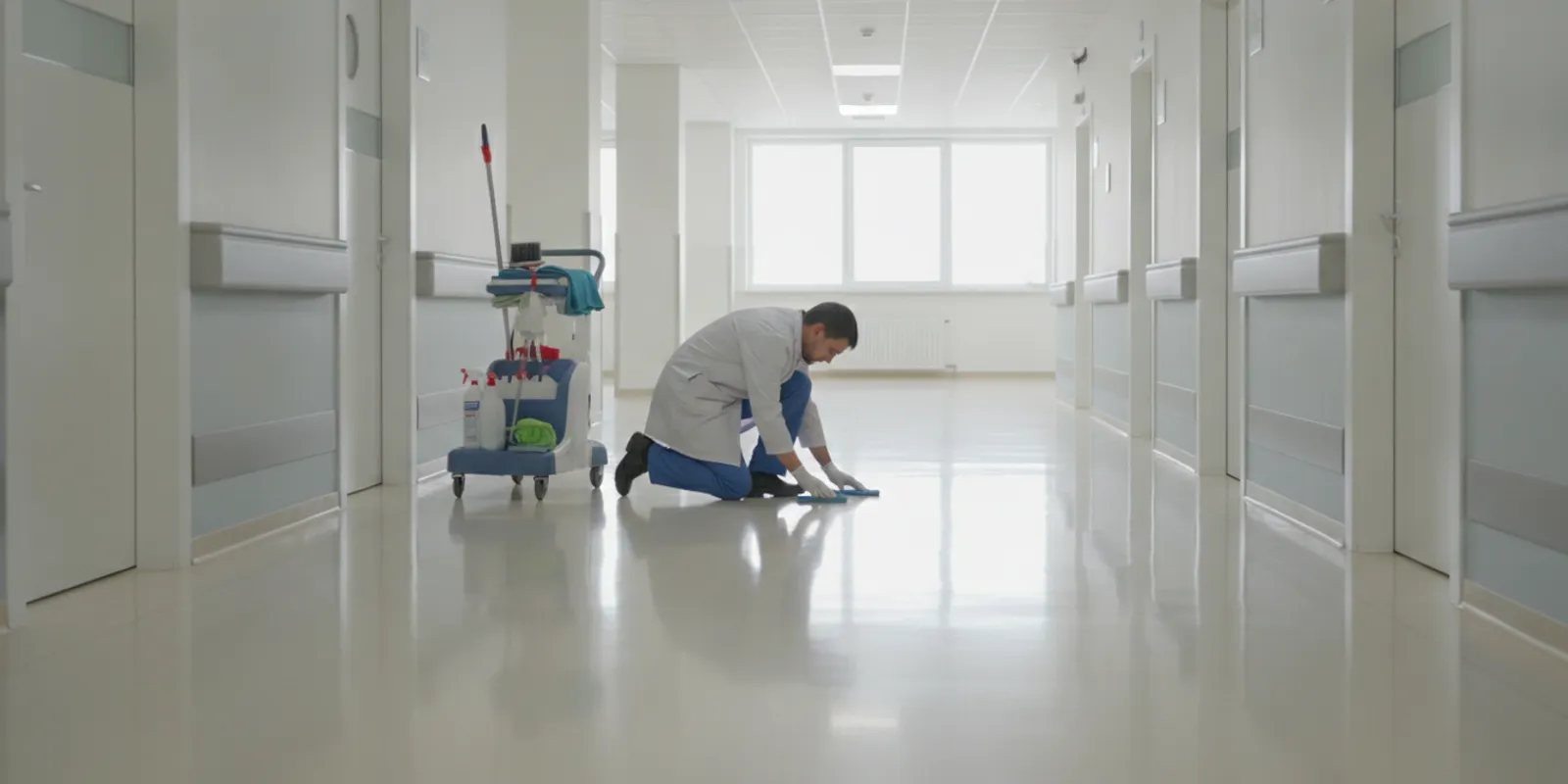
Hospital cleaning services cost depends on what must be cleaned, how often teams enter each area, and the controls needed to protect patients, staff, and operations. A useful quote connects those details to a defined scope instead of applying one flat rate to every room. Foreman Pro Cleaning works with commercial and critical environments, and this guide explains the information to gather before requesting a healthcare cleaning proposal.
Request a hospital cleaning quote
What drives hospital cleaning services cost?
The first cost driver is the facility’s actual service scope. A square-foot figure alone cannot describe the work in an operating hospital. Two areas of equal size may have very different cleaning needs because one is a public corridor and the other is a controlled clinical space with room-specific procedures, access limits, or turnover requirements.
Before comparing proposals, document the spaces included, the tasks expected in each space, and the conditions under which work must happen. A quote may cover routine environmental services, periodic detail work, or a combination. Make sure the proposal states whether it includes patient rooms, procedure areas, waiting spaces, staff areas, restrooms, floors, touchpoints, waste handling, and any specialty spaces. Ask which tasks are excluded as well.
Hospital cleaning and infection prevention are linked, but a cleaning proposal should not promise a clinical outcome. A review of hospital cleaning describes how the role of cleaning in controlling healthcare-associated infection has gained recognition over time; it is useful context for treating cleaning as an operational program rather than a generic building service (review of hospital cleaning and infection control). The quote should reflect the facility’s own infection-prevention direction and room-specific procedures.
How do facility size and room mix affect the quote?
Area matters because it helps estimate the amount of work, but the type and layout of that area matter just as much. A large, open administrative area is not equivalent to a similarly sized collection of patient rooms, restrooms, and clinical support spaces. Layout can affect travel between tasks, equipment movement, access, and the time needed to complete work without disrupting care.
Give the provider a current space inventory rather than only a total building area. Useful details include:
- Floor plans or a room list with approximate areas and room functions.
- Which rooms are occupied continuously, intermittently, or only by appointment.
- Restricted, sensitive, or controlled-access areas and their entry procedures.
- Floor types, furnishings, fixed equipment, and surfaces requiring specific handling.
- Shared spaces that need attention across more than one shift.
- Spaces that are currently out of service or scheduled to change use.
For example, a quote that treats all rooms as interchangeable can miss differences between a low-use office, a busy waiting area, and an isolation room. Define the room categories with the hospital team and make sure the bidder’s task schedule maps to them. If the facility is expanding or changing service lines, flag those plans early so the proposed labor and schedule can be reviewed before the change takes effect.
Healthcare spaces may also call for a different plan from an ordinary office. Foreman Pro’s overview of medical office cleaning discusses the importance of specialized procedures in clinical settings. A hospital scope needs to go further by identifying its own units, access rules, and approved work practices rather than borrowing a generic office checklist.
Which clinical risks and cleaning levels belong in the scope?
Clinical risk changes how work is planned. The proposal should distinguish public and administrative areas from patient-care spaces and identify any room categories that require specific sequencing, training, equipment, or sign-off. The hospital’s infection prevention and environmental services leaders should determine the applicable procedures. A contractor should price the resources and tasks required to follow that approved scope, not independently define clinical policy.
Routine cleaning, enhanced cleaning, and terminal cleaning are not interchangeable labels. Routine work supports recurring upkeep based on room use and facility protocols. Enhanced work may add tasks or increase attention under a defined condition. Terminal cleaning is a more complete room reset after a patient’s departure or another designated event, when facility protocol calls for it. The scope should say which service applies, which surfaces and furnishings are included, who releases the room, and how completion is recorded.
Do not assume a bid includes terminal cleaning simply because it uses broad language such as “clinical cleaning.” Ask for a room-by-room task list and a clear description of events that trigger each service. The hospital cleaning program review in this article on designing healthcare cleaning programs discusses considerations for program development. That supports an important scoping practice: align the service model with the facility’s needs rather than pricing an undefined general category.
Buyers should also clarify training and competency expectations. Ask how personnel are oriented to site rules, room classifications, approved cleaning agents, personal protective equipment, and escalation steps. If a role requires specific credentials or competency verification, identify the exact requirement and ask how the provider documents it. Do not treat an unverified credential, a generic training statement, or a vendor’s marketing language as a substitute for facility approval.
How do routine, enhanced, and terminal services compare?
This comparison is a scoping tool, not a universal clinical protocol. The hospital should define the tasks and decision points for its own units. Each added or changed task affects staffing, time, supplies, supervision, and documentation, so the quote should make the distinction visible.
| Service type | Typical scope question | Quote details to confirm |
|---|---|---|
| Routine cleaning | Which recurring tasks apply to each room or area? | Room list, task frequency, shift timing, included surfaces, and inspection process. |
| Enhanced cleaning | What condition or facility direction activates the added work? | Trigger, added tasks, who authorizes the change, required supplies, and recordkeeping. |
| Terminal cleaning | Which event requires a complete room reset before return to use? | Room release, task checklist, responsible party, verification, and handoff process. |
When assessing a service provider, look for the ability to coordinate standard janitorial work with specialized requirements where appropriate. Foreman Pro offers commercial cleaning services and critical environment cleaning; the hospital still needs to define which service areas and procedures belong in its project. A clear boundary prevents an ordinary scope from being mistaken for controlled-environment work.
How do staffing, schedules, and access affect hospital cleaning services cost?
Labor planning is one of the central parts of a quote. The staffing plan should match the scope, facility hours, room access, and required service windows. A schedule that looks efficient on paper may not work if staff must wait for a room release, coordinate with clinical personnel, or avoid active patient care. Include realistic access and handoff arrangements in the planning discussion.
Discuss the following scheduling and staffing conditions before a provider builds its proposal:
- Which shifts can perform work in each unit, and when are rooms available?
- Are some tasks required overnight, between appointments, or during lower-activity periods?
- How are urgent requests, room turnover, and temporary access restrictions communicated?
- What supervision and quality checks are expected, and who reviews them?
- Are there orientation, screening, escort, or badge procedures that affect access?
- How should planned absences or a temporary increase in occupied space be handled?
Be specific about coverage expectations without assuming that every hour requires the same staffing model. A hospital may require recurring service in some areas and scheduled attention in others. A day porter arrangement, for example, differs from a program delivered outside patient-facing hours. If both are under consideration, have the quote show what each covers and how responsibility transfers between shifts.
Operational experience matters because access, change control, and handoffs are part of the work. Learn more about Foreman Pro Cleaning’s team and story and the company’s background in commercial and critical environment operations. For facilities in Maryland, Washington, D.C., and Virginia, confirm service-area fit through the service locations page when preparing a request.
Discuss your hospital’s staffing and schedule needs
What documentation and quality checks should a quote include?
Documentation has a labor and management component. The facility should decide what evidence it needs to verify task completion, support handoffs, and review service issues. A quote should explain which records are included, where they are kept, who can access them, and how exceptions are reported. Do not assume that a checklist, electronic log, or inspection record is included unless the proposal says so.
Depending on the hospital’s process, useful records may include assigned task lists, completion entries, room-status or handoff notes, inspection findings, incident escalation, and periodic service reviews. Specify the record format and approval path. If documentation must fit an existing system, explain the workflow and required fields before the provider finalizes labor assumptions.
Quality checks should be defined in practical terms. Ask what is inspected, how findings are documented, how a missed or incomplete task is corrected, and who receives follow-up. Connect inspection criteria to the written scope so that the provider and hospital are evaluating the same work. For infection prevention or regulatory requirements, rely on the hospital’s designated leaders and applicable governing guidance; the cleaning proposal should not claim that a particular service alone ensures compliance.
Cost benchmarking can also be useful when it compares like with like. A published method for benchmarking cleaning services in Swiss hospitals describes cost transparency in the hospital context. It is not a rate card for a U.S. facility. Use benchmarking as a prompt to standardize definitions, scope, and accounting assumptions before comparing proposals, not as a shortcut to a price expectation.
How can hospitals compare proposals without relying on a headline price?
A lower total may reflect a narrower scope, different staffing assumptions, fewer quality checks, or excluded tasks. A higher total may include services the hospital does not need. Compare proposals line by line against one shared scope. If a bid uses different room names or service labels, request a crosswalk before making a decision.
- Standardize the facility inventory. Provide every bidder with the same room list, space types, and access notes.
- Match tasks to spaces. Require a schedule that identifies the tasks and service frequency for each area.
- Separate service levels. Identify routine work, enhanced tasks, terminal cleaning, and special projects distinctly.
- Review labor and coverage. Ask how the proposed staffing plan fits room access, shift windows, supervision, and handoffs.
- Compare exclusions and assumptions. Check supplies, floor care, waste handling, equipment, after-hours access, and records.
- Test change procedures. Agree how new spaces, a changed service level, or temporary additional work will be authorized and repriced.
For broader contract planning, Foreman Pro’s janitorial services overview can help facilities consider recurring service structures. A hospital should use its own policies, infection prevention guidance, and unit leadership to approve its detailed requirements.
Which scope changes should be priced before work begins?
Quotes are based on assumptions. The best way to avoid confusion is to record the assumptions and define a review process for changes. Changes may include newly occupied rooms, an altered clinical function, revised access windows, additional documentation, a special project, or a different frequency requested by the facility. A change in one unit should not automatically be treated as a change to every area.
Ask the provider how it will flag a difference between the approved scope and conditions at the facility. Agree who can authorize additional work, how its impact will be explained, whether the change is temporary or recurring, and when the revised scope takes effect. Keep clinical decisions with the hospital’s authorized personnel; the cleaning team should receive clear instructions through the agreed process.
A useful proposal states its review cadence and names the operational information needed for that review. That may include updated room inventories, access patterns, service logs, inspection results, or a list of requested changes. When the scope is transparent, both sides can discuss the work itself instead of trying to interpret an unexplained total.
What should a hospital include in a quote request?
Prepare a concise request package with the information a provider needs to plan responsibly. Include the facility or campus location, room inventory, unit classifications, service hours, access rules, task expectations, documentation requirements, and the hospital contacts responsible for operational and clinical decisions. Flag any known transitions or planned changes that could affect the scope.
Ask each bidder to return a written scope, staffing and schedule assumptions, service exclusions, quality and reporting approach, and a process for proposed changes. Request that terminal cleaning and any enhanced work be described separately from routine tasks. If the hospital needs a particular training, credential, or regulatory reference, specify it and ask how it will be verified rather than accepting a broad assurance.
Hospitals in Foreman Pro’s service region can use the contact page to request a discussion. For related healthcare context, see the company’s guide to cleaning considerations in urgent care settings; a hospital’s own room classifications and protocols must still drive the quote.
Request a scope review for your facility
What questions do hospital leaders ask about hospital cleaning services cost?
Can a hospital cleaning quote be based only on square footage?
Square footage helps describe the facility, but it does not show room function, cleaning frequency, access restrictions, risk controls, or documentation needs. Provide a room-level inventory and task schedule so the quote reflects the actual scope.
Is terminal cleaning automatically included in routine service?
No. Ask the provider to identify terminal cleaning as a separate service level, explain its trigger and tasks, and document the room release and completion process according to the hospital’s protocols.
What makes one hospital proposal different from another?
Proposals may use different assumptions for tasks, schedules, labor coverage, supervision, records, supplies, and exclusions. Compare each proposal against the same written scope before weighing the totals.
How should a hospital handle scope changes?
Agree in advance who can authorize a change, how the impact will be reviewed, whether it is temporary or ongoing, and how the updated work will be documented. Route clinical requirements through authorized hospital personnel.
How can you plan the next step?
Hospital cleaning services cost is best evaluated through a transparent, room-specific scope that connects service levels, staffing, schedules, documentation, and change control. Gather those details before requesting proposals so your team can compare the work clearly and choose a plan that fits facility operations.
