
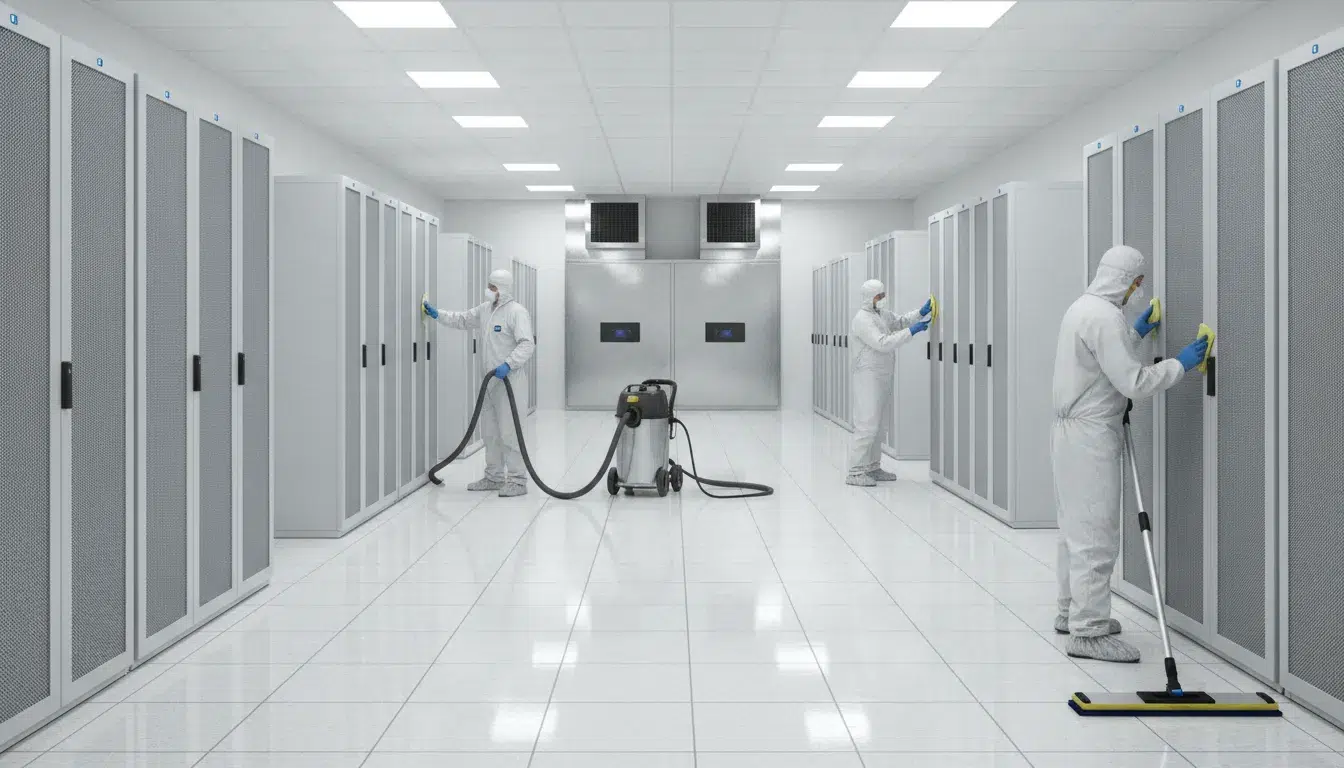
Effective post-construction data center cleaning is a commissioning control, not a cosmetic final touch. It removes construction residue from airflow paths, equipment zones, and concealed spaces before fans, cooling systems, or sensitive hardware can redistribute it. For owners, facility managers, commissioning agents, and general contractors, the work must be sequenced, measurable, and documented against project-specific acceptance criteria.
Plan a commissioning-ready data center cleaning with Foreman Pro Cleaning.
A data hall can look finished while fine gypsum dust remains on cable trays, concrete residue sits beneath raised floor tiles, and metal shavings remain near penetrations. Once air movement begins, that contamination can migrate into cabinets, filters, coils, and electronic assemblies. The checklist below separates critical-environment cleaning from ordinary construction cleanup and gives project teams a practical framework for controlling that risk.
Define the post-construction data center cleaning scope
A defensible cleaning scope identifies the rooms, surfaces, concealed spaces, exclusions, sequencing constraints, methods, and acceptance evidence required before commissioning. It assigns responsibility at trade boundaries and distinguishes bulk construction cleanup from the precision clean needed to protect critical airflow routes and equipment areas.
The scope should begin with the owner’s project requirements, design documents, commissioning plan, construction schedule, and equipment installation sequence. It should cover the data hall as well as spaces that can introduce contamination into it, including electrical rooms, mechanical galleries, staging areas, corridors, loading routes, and adjoining support rooms. The team should also identify pressure relationships and shared return-air pathways that could move dust across a boundary.
Separate builder clean from critical clean
General post-construction cleaning normally removes packaging, offcuts, adhesive residue, and visible soil so a building can be occupied. Commissioning-stage data center cleaning starts after that baseline has been achieved. It targets fine and hidden residue with controlled tools and techniques selected for critical spaces. Treating the two phases as interchangeable creates gaps in responsibility and encourages precision crews to spend time removing debris that should have been cleared by construction trades.
Write a clear turnover condition for every zone. For example, the GC may be responsible for removing pallets, wire scraps, fasteners, ceiling cuttings, and trade tools before a critical cleaning team enters. The cleaning team may then be responsible for HEPA vacuuming, low-lint wiping, subfloor work, and documented inspection. Any active work that can regenerate dust should suspend final acceptance for the affected zone.
Map boundaries and exclusions
Mark each cleaning zone on a floor plan and state whether the scope includes the tops and undersides of raised floor tiles, structural ledges, cabinet exteriors, cable pathways, busway exteriors, accessible duct exteriors, blanking panels, and equipment that has already been installed. Define prohibited activities, energized equipment restrictions, fall-protection requirements, tile-lifting rules, and surfaces that may be touched only by an authorized trade.
A pre-clean walk with the GC, commissioning agent, facility representative, and cleaning lead prevents assumptions. Foreman Pro Cleaning can use that walk to align methods with the actual site conditions, but acceptance authority should remain clearly assigned in the project plan.
Sequence cleaning around construction and commissioning
The final precision clean should occur after dust-generating trades and major punch-list corrections are complete, after bulk debris is removed, and before sensitive equipment exposure or airflow tests can spread residue. A phased zone-release plan is often more practical than one building-wide cleaning event.
Timing determines whether a clean space stays clean. Drywall finishing, concrete drilling, firestopping, ceiling work, cable termination, and floor-tile cutting can all reintroduce particles. If the final clean occurs while those activities continue nearby, the project pays for rework and may still reach commissioning with uncontrolled residue.
Use readiness gates before mobilization
Before precision cleaning begins, confirm that envelope penetrations are sealed or controlled, dust-producing work is complete in the zone, temporary barriers are intact, trash and unused materials are removed, and the area has stable lighting and safe access. Confirm the status of permanent and temporary air-handling systems. The commissioning authority should decide whether systems remain off, operate under a controlled mode, or require protected filters during each phase.
Coordinate lockout and energized-system restrictions before cleaners approach electrical distribution, busways, cabinets, or mechanical equipment. Cleaning personnel should never infer that a component is de-energized because it appears unfinished. Access approval and hazard controls must come from the party responsible for the system.
Apply a phased release plan
- Establish the dirty-to-clean boundary: Define entry points, material routes, barriers, and rules for tools, footwear, carts, and waste removal.
- Complete the builder clean: Remove bulk debris, packaging, offcuts, loose fasteners, and trade equipment before precision work starts.
- Clean overhead and vertical surfaces: Work from high to low so dislodged residue can be captured during later floor and subfloor steps.
- Clean airflow paths and floor systems: Address accessible plenums, grilles, tiles, pedestals, and slab surfaces under approved controls.
- Inspect and correct: Record deficiencies, reclean affected areas, and obtain zone acceptance before releasing them.
- Protect the accepted zone: Restrict access and require a reclean if later work breaches the clean condition.
Connect the sequence to commissioning milestones, not just calendar dates. Functional testing, air balancing, equipment startup, integrated systems testing, and owner training can each change access patterns or air movement. The plan should state what must be clean before each milestone and what follow-up inspection is required afterward.
Set acceptance criteria before work begins
Acceptance criteria should define what will be inspected, the method of inspection, who decides pass or fail, and how exceptions are corrected. Visual cleanliness is useful but incomplete; project teams may also specify wipe checks, photographs, particle measurements, or other tests appropriate to the design and risk.
Vague requirements such as “clean to data center standards” are difficult to price, execute, or defend. A useful specification translates expectations into observable conditions. It might require no visible loose debris on accessible surfaces, no residue transfer during an agreed wipe check, completed photo documentation for concealed zones, and closure of every deficiency before release.
Choose evidence that matches risk
Visual inspection under adequate lighting remains important because it identifies scraps, deposits, stains, and missed surfaces. A controlled wipe check can expose fine residue that is hard to see. Photographs are especially valuable beneath raised floors and above ceilings because those areas become difficult to inspect later. If the project specifies airborne or surface particle measurements, define the instrument, sampling locations, operating state, thresholds, and responsible testing party before cleaning begins.
ISO 14644-13 may provide useful guidance when a team develops cleaning procedures for particle contamination. However, a completed clean does not automatically establish ISO compliance, and the guidance should not be represented as a universal certification requirement for data centers. Any formal cleanliness classification or test requirement must be explicitly specified and verified using the agreed method.
Create an inspection and correction workflow
Use a zone-based inspection sheet tied to room names or drawing references. Record the initial condition, work completed, exceptions, corrective action, and final acceptance. If inspection finds contamination caused by another trade, document both the condition and its likely source. That record helps the GC control repeat contamination rather than repeatedly treating the symptom.
The acceptance team should include someone authorized to interpret scope and release the zone. Cleaning crews can document results, but they should not be asked to unilaterally approve owner or commissioning criteria. A defined signoff chain protects schedule, quality, and accountability.
Clean above-floor surfaces from high to low
Above-floor cleaning should progress from overhead pathways and high ledges to walls, cabinets, floor grilles, and walking surfaces. HEPA-filtered capture and low-lint wiping prevent fine construction residue from being pushed into airflow openings or redistributed onto already accepted areas.
Begin with accessible high surfaces because residue dislodged there will settle below. Examine the tops of cable trays, ladder racks, raceways, light fixtures, conduits, piping, door frames, wall caps, and cabinet exteriors. Coordinate access to overhead systems and do not disturb cables, fire protection devices, controls, labels, or commissioning instruments without authorization.
Protect equipment and pathways
Use tools that fit the surface and contamination. HEPA-filtered vacuuming can capture loose dry residue at its source. Low-lint wiping may be appropriate for smooth surfaces when the approved cleaning product and moisture level will not harm finishes or equipment. Avoid uncontrolled spraying. Apply approved product to the cleaning material when practical, rather than atomizing liquid near equipment or openings.
Cabinets and racks require explicit scope limits. Exterior top panels, doors, and accessible bases may be included, while internal components and energized equipment may require a separate procedure or vendor authorization. Never open cabinets, remove panels, or clean internal electronics unless the written scope, hazard review, and authorization allow it.
Finish floors without recontamination
After overhead and vertical work passes inspection, clean floor grilles, perforated tiles, solid tiles, transitions, and perimeter edges. Do not sweep dry dust toward perforations. Inspect tile openings and brush seals for trapped scraps or residue. Use a controlled method that captures soil rather than moving it into the plenum.
Plan personnel movement so completed aisles are not repeatedly crossed with dirty carts or footwear. Entry controls should continue until the area is transferred to the owner or equipment-installation team. A clean floor is not meaningful if an uncontrolled loading route immediately tracks construction soil through the room.
Control raised-floor and subfloor cleaning
Raised-floor cleaning requires a controlled tile-lifting plan, safe access, protection of cables and utilities, and systematic debris removal from the slab, pedestals, stringers, tile undersides, and airflow paths. Teams must preserve floor stability and avoid creating new contamination while exposed sections are open.
The subfloor can conceal wire clippings, fasteners, concrete dust, packaging fragments, and residue from floor-system installation. Where it serves as an air-supply plenum, leftover material can enter the cooling stream. Even where it is not an active plenum, concealed debris complicates maintenance, inspections, leak response, and later cable work.
Approve the tile-lifting method
Before lifting tiles, obtain the floor manufacturer’s guidance and the facility’s safe-work rules. Determine how many adjacent tiles may be removed, how open areas will be guarded, where removed tiles will be staged, and how their orientation will be maintained. Coordinate around underfloor power, controls, cooling components, piping, and communications. Stop and escalate any unexpected moisture, damaged cable, loose pedestal, sharp object, or unidentified hazard.
Clean in mapped sections and keep the dirty side of removed tiles from contacting clean surfaces. Capture loose debris first, then HEPA vacuum accessible slab areas, pedestal bases, stringers, corners, and tile undersides as approved. Do not drag vacuum hoses across vulnerable cables or use liquids beneath the floor unless the procedure explicitly permits them.

Inspect airflow controls and penetrations
Cleaning personnel should note, but not independently alter, missing seals, open penetrations, displaced airflow barriers, and damaged components. These conditions can affect pressure and airflow performance and should be routed to the responsible trade or commissioning agent. Reinspect after correction because repair work may generate fresh residue.
The data center cleaning checklist can support ongoing maintenance after turnover, but commissioning documentation should remain specific to the construction project, zones, and acceptance gates.
Ask Foreman Pro Cleaning about a site-specific post-construction data center cleaning plan.
Protect HVAC and critical airflow paths
Airflow systems should be managed as contamination pathways during cleaning and commissioning. Coordinate system operating status, filter protection, grille and plenum access, and post-test inspections so construction dust is captured rather than drawn through cooling equipment or redistributed into accepted data hall zones.
Air movement can turn a localized residue problem into a facility-wide problem. The cleaning and commissioning teams should jointly decide when fans or cooling equipment may operate, what filtration or temporary protection is required, and which zones must be inspected after airflow changes. These decisions depend on the design and equipment, so they belong in the commissioning plan rather than in an improvised cleaning procedure.
Coordinate before startup and testing
Before startup, inspect accessible return and supply paths, floor grilles, containment components, and nearby surfaces for loose residue. Confirm that temporary construction filters or covers are managed by the responsible party and will not interfere with required testing. Do not clean internal HVAC or cooling equipment unless that work is expressly included and authorized by the manufacturer or responsible trade.
Air balancing and functional tests can dislodge residue from pathways that appeared clean while systems were off. Plan a follow-up inspection after those activities. If residue appears, trace the likely source, correct it, and reclean affected zones before sensitive equipment is exposed.
Maintain containment between zones
Use physical boundaries and controlled access to separate active construction from accepted spaces. Pay attention to door openings, shared corridors, penetrations, and pressure relationships. A barrier is only useful if material routes and personnel behavior support it. The GC should enforce housekeeping and dust controls outside the cleaned zone so the critical clean is not expected to compensate for uncontrolled work elsewhere.
When a clean zone must reopen for punch-list activity, define a breach protocol. It should identify protective measures, required cleanup by the trade, and the inspection needed before the zone returns to accepted status. This makes re-entry predictable and protects the commissioning schedule.
Select ESD-aware methods, tools, and products
Critical-space cleaning equipment should capture fine particles, minimize lint and residue, and support the facility’s electrostatic discharge controls. Tool and product selection must also account for equipment status, surface compatibility, moisture restrictions, grounding requirements, and manufacturer guidance rather than relying on ordinary janitorial practices.
ESD risk changes with equipment, humidity, flooring, grounding, clothing, and work methods. Calling a tool “anti-static” is not enough. The project team should approve the approach and verify that workers understand the facility’s ESD control plan. If sensitive equipment is installed or energized, the work may require additional restrictions or a separate method statement.
| Decision area | Commissioning-stage approach | Risk to control |
|---|---|---|
| Particle capture | Use appropriately maintained HEPA-filtered vacuum equipment and inspect accessories before entry. | Fine residue escaping exhaust or transferring between zones. |
| Wiping materials | Use approved low-lint materials, folded and changed on a controlled schedule. | Lint deposition and cross-contamination. |
| Cleaning products | Confirm surface compatibility, residue profile, application method, and moisture limits. | Film, finish damage, corrosion, or liquid intrusion. |
| ESD controls | Follow the site’s approved grounding, clothing, tool, and access requirements. | Electrostatic discharge near sensitive equipment. |
| Tool control | Inventory, inspect, and clean tools before they enter an accepted zone. | Foreign material and imported construction soil. |
Avoid methods that redistribute contamination
Dry sweeping, compressed-air blowdown, uncontrolled spraying, and conventional shop vacuums can move fine residue instead of capturing it. Cotton string mops and shedding cloths may leave fibers. Strongly scented or residue-forming products may be incompatible with the space or owner requirements. Select the least disruptive effective method and document what was used.
Control tools and consumables
Inspect vacuum hoses, attachments, wipes, carts, and footwear before entry. Use dedicated or thoroughly cleaned equipment for accepted zones. Change vacuum filters and collection materials according to the equipment procedure and site controls, not only when suction visibly declines. Bag waste before moving it through clean areas, and use an approved removal route.
Foreman Pro Cleaning personnel can work within site-specific requirements, but the owner, GC, and commissioning authority should communicate those requirements before mobilization. That preparation prevents last-minute substitutions and helps the team arrive with compatible equipment and documentation.
Verify, document, and preserve the clean condition
Closeout should prove what was cleaned, where, when, by which method, and with what result. A zone-based package combines inspection records, photographs, exceptions, corrective actions, and acceptance signatures, then defines access controls that preserve the verified condition until commissioning and turnover are complete.
Verification is what turns cleaning from an activity into a commissioning deliverable. Records should allow an owner or commissioning agent to connect each accepted area to the scope and criteria. They should also make unresolved conditions visible before equipment installation or integrated testing makes correction more difficult.
Build a useful closeout package
At minimum, record the facility and zone identifier, cleaning date, crew lead, methods, equipment, approved products, inspection date, exceptions, corrections, and accepting party. Include before-and-after photographs where they add evidence, particularly for concealed areas. Photos should be labeled to show location and orientation rather than delivered as an unorganized image folder.
Document conditions outside the cleaning scope that could threaten readiness, such as an open penetration, a recurring leak, or active dusty work beside an accepted room. Route each issue to an owner and record whether it requires recleaning. This is not a substitute for the GC’s punch list; it is a focused record of conditions affecting cleanliness.
Preserve acceptance through turnover
After acceptance, keep doors controlled, restrict food and unnecessary traffic, protect material routes, and require clean tools and carts. Establish who can authorize entry and who decides whether an activity triggers reinspection. If servers or other equipment are installed after the clean, coordinate unpacking and packaging removal so cardboard fibers, foam, and pallet soil do not compromise the room.
A final readiness review should compare cleaning acceptance with the next commissioning milestone. Confirm that unresolved deficiencies are closed, protective controls remain in place, and the responsible party knows when those controls may be removed. This last coordination step protects the work already completed and gives stakeholders a traceable basis for release.
Frequently asked questions
When should post-construction data center cleaning occur?
Schedule the final critical clean after dust-producing trades and corrective construction work are complete, but before sensitive IT equipment is exposed and before commissioning activities can redistribute residual debris. Use phased rough and precision cleans when the construction schedule requires continued controlled access. Reinspect after airflow tests or any work that breaches an accepted zone.
Is general post-construction cleaning sufficient for a data center?
No. General post-construction cleaning removes bulk debris and prepares ordinary occupied spaces. A data center commissioning clean also addresses hidden plenums, rack and pathway surfaces, low-lint methods, ESD-aware work practices, controlled sequencing, and documented acceptance criteria. Both phases matter, but they have different purposes and should have clearly assigned responsibilities.
Does a commissioning clean certify ISO 14644 compliance?
Not by itself. ISO 14644-13 can be useful guidance when developing particle-cleaning procedures, but it should not be presented as automatic certification or as a universal data center requirement. Any specified cleanliness class or acceptance threshold requires an agreed test method, defined operating state, qualified verification, and project-specific acceptance authority.
What should be included in the cleaning closeout package?
The package should identify scope boundaries, dates, zones, methods, products, equipment, exceptions, corrective actions, inspection results, and before-and-after photographs. It should also record who accepted each area and any restrictions that must remain in effect until equipment installation or turnover. Organize records by zone so they are easy to audit.
Prepare the data center for commissioning
A successful clean begins with aligned scope, realistic sequencing, approved critical-space methods, and measurable acceptance. Foreman Pro Cleaning helps project teams address visible and concealed construction residue while working within site-specific safety, access, and commissioning controls. The result is a documented clean condition that can be protected through startup, testing, and turnover.
Discuss your commissioning-stage data center cleaning requirements.
