
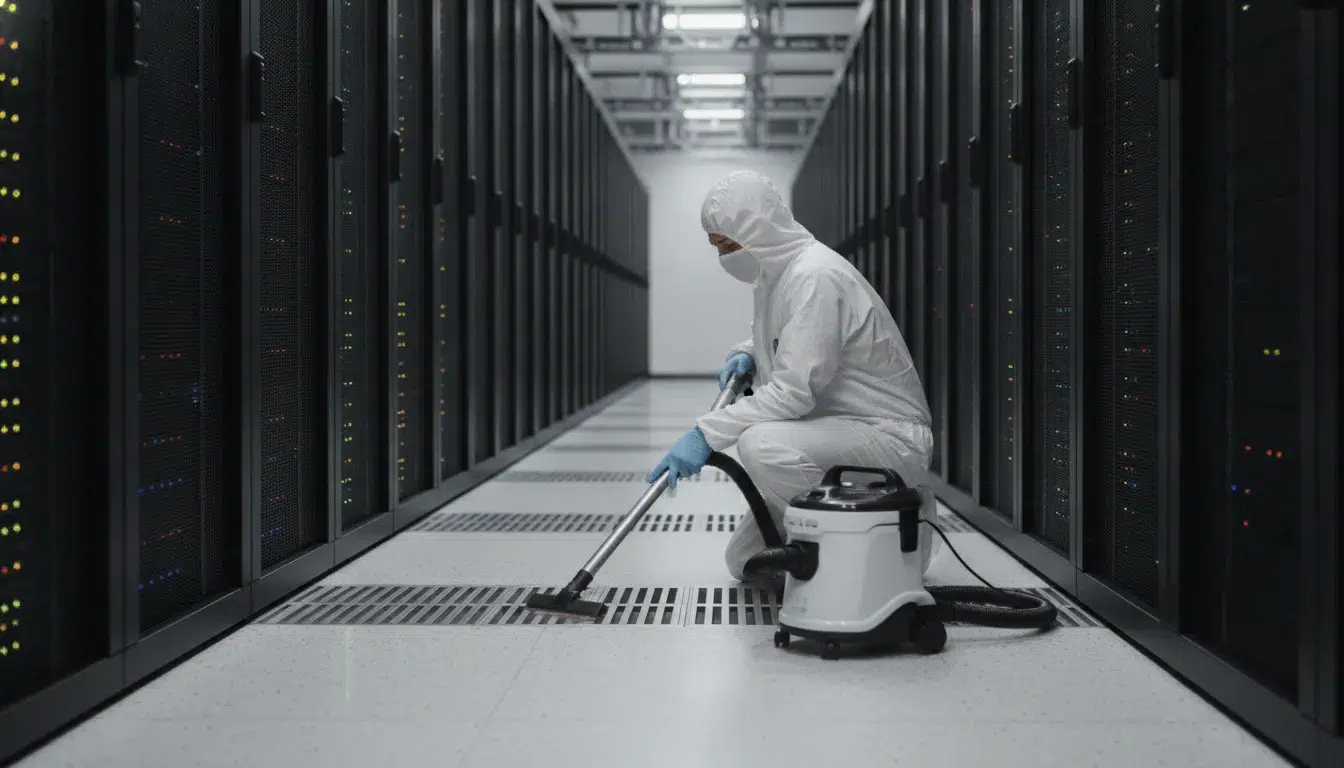
How often should a data center be cleaned? Most facilities need continuous housekeeping controls, daily visual inspections, frequent attention to entrances and traffic paths, scheduled surface cleaning, and a planned deep clean of less-accessible areas. There is no responsible one-frequency-fits-all answer. The right schedule separates top floors, equipment-adjacent surfaces, high work, and subfloor plenums, then adjusts each interval based on particulate levels, construction, traffic, airflow, and operational requirements.
Request a tailored data center cleaning plan from Foreman Pro Cleaning.
A quiet server room and a busy colocation facility should not follow the same calendar. Even two halls in one building may have different risk profiles. This guide gives facilities managers and IT operations leaders a practical starting framework, plus the triggers that should shorten the schedule before contamination becomes an uptime concern.
How often should a data center be cleaned?
A practical data center cleaning program uses layers of frequency rather than relying on one annual deep clean. Start with daily observation and contamination prevention. Add routine care for traffic-exposed floors and approved surfaces. Schedule specialized work for racks, facility equipment, high areas, and underfloor spaces according to risk and site procedure.
| Zone or task | Practical starting interval | Shorten the interval when |
|---|---|---|
| Entries, tack mats, staging areas, and visible debris checks | Daily or each staffed shift | Traffic rises, weather tracks in soil, or deliveries increase |
| Top floors and approved traffic paths | Weekly to monthly, with spot response as needed | Visible residue, frequent access, or particle trends appear |
| Rack exteriors, tops, ledges, and approved equipment surfaces | Monthly inspection; planned cleaning quarterly to semiannually | Dust returns quickly or air intakes show deposition |
| General surfaces, containment, facility equipment exteriors, and high work | Semiannually as a common deep-clean baseline | Airflow patterns, nearby work, or site standards demand more |
| Raised-floor subfloor plenum and supporting structure | Inspect at least annually; deep clean based on findings and risk | Construction debris, cable work, corrosion debris, or particulate accumulation is found |
| Post-construction or incident response | Immediately after containment and authorization | Any activity introduces airborne or settled contamination |
These intervals are planning baselines, not a substitute for the facility’s procedures, manufacturer guidance, contractual requirements, or environmental targets. A specialized cleaning provider should inspect the site and document an approved scope before work begins. Foreman Pro Cleaning uses a walkthrough and discovery process to develop customized plans for critical environments across Maryland, Washington D.C., and Virginia.
Why a risk-based schedule works better than a fixed calendar
A fixed date answers when a crew arrives. It does not answer whether the right zones receive attention at the right time. Contamination risk changes as people, materials, air, and maintenance work move through the facility. A schedule that treats every surface the same can over-service low-risk areas while leaving a developing issue near critical airflow paths.
Risk-based scheduling starts by dividing the facility into zones. Entries, loading and staging areas, and frequently used aisles usually need closer observation because they receive more traffic. White-space surfaces near active equipment require approved static-safe methods and careful coordination. High work and subfloor areas may receive less frequent service, but they require specialized access, planning, and controls.
The program should also define who owns inspections, which findings trigger escalation, which tools and products are approved, and how completed work is recorded. Foreman Pro’s data center cleaning checklist for facility managers can help teams organize those responsibilities without confusing routine inspection with specialist cleaning.
Set top-floor cleaning frequency by traffic and flooring system
The top floor often shows contamination first because people, carts, packaging, and maintenance activity move across it. Daily visual checks can identify spills, loose debris, tracked-in soil, and damaged entry controls early. Actual cleaning frequency should reflect traffic, the flooring material, visible conditions, and the approved care method.
High-traffic aisles and entries may need weekly attention or more frequent spot response. Lower-traffic zones may remain on a monthly routine with inspections between visits. A facility should not wait for a scheduled deep clean when visible debris appears. The issue should be documented and addressed through the approved process.
Floor care inside a critical environment is not ordinary mopping or janitorial service. Procedures must account for sensitive equipment, airflow, moisture control, and electrostatic-discharge requirements. Using an unsuitable product or technique may damage finishes or introduce risk. Foreman Pro provides raised-floor and anti-static top-floor cleaning as part of its critical environment services.
Use recurring observations to tune the calendar. If the same aisle shows residue days after cleaning, investigate the source rather than only increasing service. Entry controls, packaging practices, construction barriers, or traffic routing may need attention.
How often should equipment surfaces and racks be cleaned?
Approved equipment-adjacent surfaces should be inspected monthly and cleaned on a planned interval based on deposition, airflow, access rules, and equipment guidance. A quarterly to semiannual specialist service is a useful starting point for many facilities, but visible dust at rack tops, door tracks, containment surfaces, or air-intake areas may justify earlier action.
Scope matters. Rack exteriors, cabinet tops, doors, ledges, and facility equipment exteriors are different from energized internal components. Any work inside cabinets or close to active hardware must follow the site’s authorization process and manufacturer requirements. Cleaning teams should never improvise around cables, vents, or live systems.
During each inspection, look for recurring dust patterns, residue near air intakes, debris around cable pathways, and inaccessible areas that need a planned maintenance window. These observations help facilities teams distinguish a one-time issue from a contamination source that requires a change in controls.
Coordinate cleaning with operational windows
Planned maintenance windows provide an opportunity to reach areas that cannot be serviced safely during ordinary operations. Review the cleaning scope with IT operations before the window begins, including access boundaries, authorized surfaces, equipment state, escalation contacts, and stop-work conditions. That preparation helps the cleaning team complete approved work efficiently without expanding the scope around live systems.
Not every routine surface visit requires downtime. Foreman Pro can work around facility schedules, and its technicians are trained for critical environments. The facility’s own procedures remain the deciding factor. Scheduling should reflect both contamination risk and the operational controls needed for each task.
Plan subfloor cleaning from inspection findings
The raised-floor plenum can remain out of sight while collecting debris from installation, cable work, tile access, and ongoing operations. It can also form part of the airflow system. That combination makes underfloor work important and sensitive. A good baseline is an annual documented inspection, followed by deep cleaning at least annually when site conditions and findings support it. Some controlled facilities may need a different interval.
Subfloor scope can include the plenum, cable trays and baskets, pedestal heads and bases, stringer systems, and the underside of approved floor panels. Inspections may also identify penetrations, sealing issues, corrosion debris, or other conditions that need escalation. Review Foreman Pro’s raised-floor cleaning guide for data centers for more detail on planning this work.
Underfloor cleaning should be performed by personnel trained for critical environments. Removing tiles, moving around cables, and operating equipment near airflow paths require coordination with facility procedures. The crew should use approved HEPA-filtered equipment and static-safe techniques, document observations, and avoid disturbing systems outside the authorized scope.
What should trigger an extra cleaning visit?
The most useful schedule has clear event-based triggers. Do not wait for the next quarterly or annual date when a change introduces contamination risk. Add an inspection and, when findings warrant it, an authorized specialist cleaning after any of the following:
- Construction or renovation: Cutting, drilling, ceiling work, wall work, and flooring projects can create fine particulate that travels beyond the immediate work zone.
- Cable installation or equipment refreshes: Accessing tiles and moving materials can disturb settled debris or introduce packaging residue.
- Elevated particulate readings: Trends above the site’s normal baseline should prompt source investigation and a review of the cleaning scope.
- Unusual traffic or deliveries: Large projects, tours, vendor visits, and staging activity can increase tracked-in contamination.
- Water, smoke, or other incidents: Incident response requires a site-specific plan and coordination with the responsible operations team.
- Visible accumulation: Dust on rack tops, air-intake areas, ledges, floor edges, or subfloor structures is a reason to act, not merely record the next date.
Post-construction work deserves particular attention because fine debris can settle in difficult-to-see areas. A phased approach during the project is often more effective than waiting until the end. The post-construction data center cleaning checklist explains how teams can control and verify conditions before normal operations resume.
How do particulate levels and airflow change the schedule?
Visible cleanliness alone cannot define risk. Small particles may settle on surfaces, move through airflow paths, or collect where routine walkthroughs do not reach. Environmental sampling and trend data can show whether the current controls and intervals are working. The value is in comparing results over time and connecting changes to facility activity.
If readings rise after cable work, construction, a change in filtration, or increased traffic, review those events before simply scheduling more of the same cleaning. The source may require containment, entry-control changes, or adjustments to work practices. Cleaning is one part of the contamination-control program.
Airflow design also affects where particles deposit. Returns, intake areas, containment surfaces, floor openings, and the subfloor may have different exposure. Use inspection findings and site data to decide which zones need a shorter interval. Coordinate any work near airflow or cooling equipment with facility operations.
Use reports to improve the next schedule
A post-service report should do more than confirm that a visit occurred. It should record the completed scope, observations, inaccessible areas, exceptions, and recommended follow-up. Comparing several reports can reveal repeat deposition at one intake, persistent debris near an entry, or a subfloor area affected by ongoing cable work.
Those patterns make frequency decisions more defensible. Instead of increasing every service interval, the facility can target the zone and source that need attention. It can also document why a lower-risk area remains on its existing schedule.
Build a documented professional cleaning program
A reliable program connects each frequency to an owner, scope, approved method, and completion record. Begin with a facility walkthrough that covers the cleaning history, flooring and airflow design, active projects, access requirements, known contamination sources, and operational constraints.
- Map the zones. Separate support spaces, entries, top floors, equipment-adjacent surfaces, high work, and subfloor areas.
- Assign inspection and cleaning intervals. Use the practical baselines above, then adjust them to site risk and requirements.
- Define approved methods. Record ESD-safe procedures, HEPA-filtered equipment requirements, approved products, and access controls.
- Create event triggers. Specify when construction, particle readings, incidents, or visible debris require escalation.
- Document every visit. Keep completed scopes, findings, exceptions, and recommended follow-up actions.
- Review the program. Reassess frequencies after major work and at least annually using inspection and trend data.
Foreman Pro Cleaning’s critical-environment process includes consultation, a custom program, precision cleaning, quality assurance, post-delivery reporting, and ongoing program assessment. Its team brings experience in both IT operations and facilities management, helping align cleaning work with the realities of mission-critical environments.
Frequently asked questions
Is annual data center cleaning enough?
Annual service alone is usually not a complete program. Daily inspections, contamination-prevention controls, and more frequent attention to traffic-exposed or equipment-adjacent surfaces are often needed. Annual work may be an appropriate baseline for inspecting and deep cleaning certain subfloor or high-access areas, depending on risk.
Should a data center be cleaned after construction?
Yes. Construction, renovation, drilling, and cable work can introduce or disturb particulate. The facility should use containment during the project, inspect affected and adjacent zones, and complete authorized post-construction cleaning before returning the area to normal service.
Can ordinary janitorial staff clean a data center?
General support spaces may fall within a janitorial scope, but work in critical areas requires specialized training, approved methods, and coordination with site procedures. Sensitive equipment, airflow, electrostatic-discharge controls, and uptime requirements make data center cleaning different from standard janitorial cleaning.
Who should set the cleaning frequency?
Facilities management and IT operations should set the program with input from a qualified critical-environment cleaning provider. The final schedule should reflect site standards, equipment guidance, environmental data, operational requirements, construction plans, and documented inspection findings.
Schedule the right cleaning frequency for your facility
The best answer to how often should a data center be cleaned is a documented schedule that changes with risk. Daily checks, routine top-floor and surface care, planned specialist cleaning, and annual subfloor review provide a strong starting framework. Foreman Pro Cleaning develops customized critical-environment cleaning plans for data centers across Maryland, Washington D.C., and Virginia, with services available around facility schedules.
Request a data center cleaning consultation with Foreman Pro Cleaning.
