
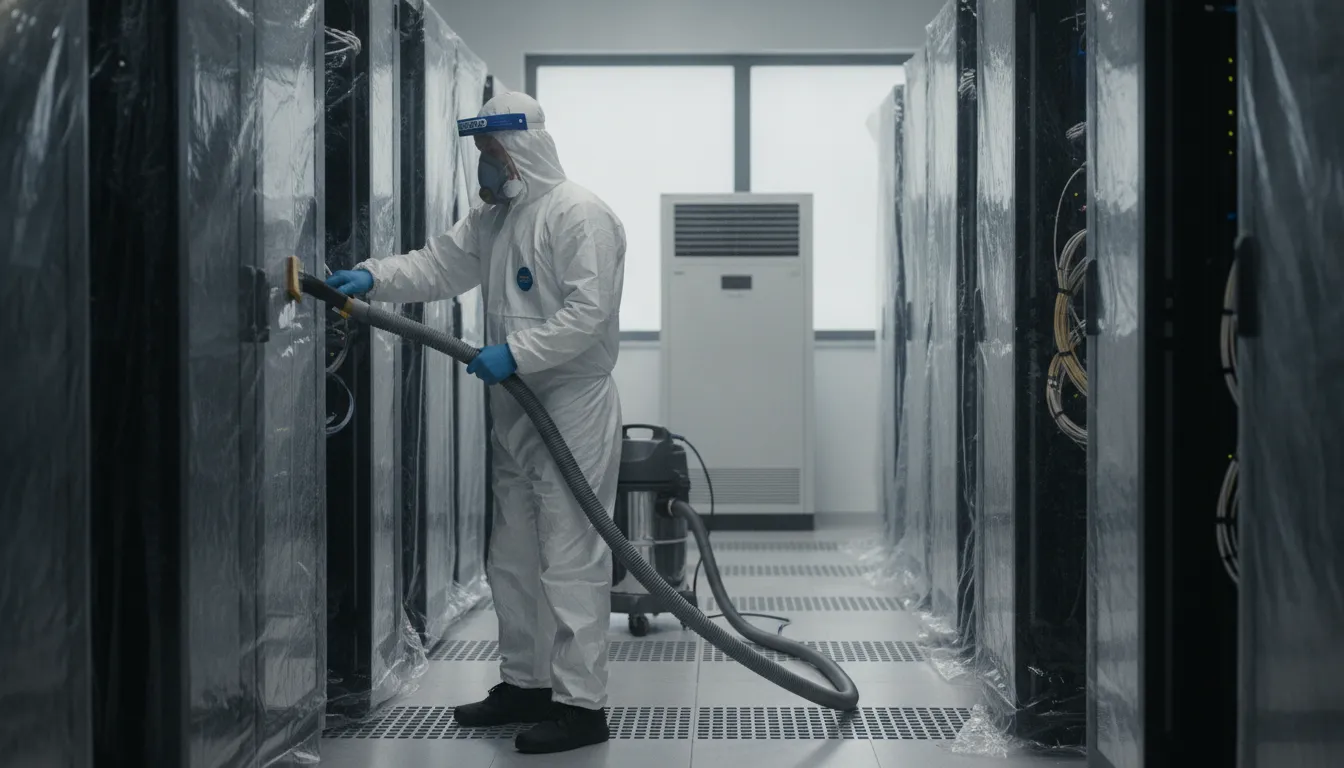
In a sensitive facility, cleaning is part of operational risk management, not a routine appearance task. Particulates, airflow, equipment sensitivity, maintenance windows, and site procedures all influence how work should be planned and performed.
Controlled contamination services are facility-specific programs that assess contamination risks, define written procedures, train technicians, use appropriate equipment, and document inspection and reporting. The objective is to support the environment’s intended operation. Each data center, laboratory, cleanroom, or command center has different requirements.
Request a facility-specific controlled contamination service assessment
Foreman Pro Cleaning builds this type of work around evaluation, documented SOPs, trained personnel, coordinated scheduling, and quality verification. Understanding what the service includes starts with separating a controlled contamination program from generic commercial cleaning.
What Are Controlled Contamination Services?
Controlled contamination services are a facility-specific cleaning and contamination-control program for environments where particulates, residues, equipment sensitivity, or operational continuity require more than a general checklist. The work begins with an evaluation of cleaning history, site needs, and scheduling preferences. A tailored program then reflects the facility’s conditions and priorities. Foreman Pro Cleaning’s critical environment cleaning services follow this assessment-led model.
The program should define what will be cleaned and how each area will be serviced. It should also identify appropriate equipment and products. Coordination with facility operations belongs in the same plan. That distinction matters because a laboratory, cleanroom, data center, broadcast studio, or command center can have different contamination pathways, surface materials, access controls, and maintenance windows. A method suitable for one space should not be treated as a universal protocol for another.
For laboratory environments, the service model may include contamination-control procedures and equipment-sensitive protocols. These protect the workspace and the activities taking place inside it. The applicable requirements should be documented in written procedures rather than left to individual interpretation. Cleaning schedules should identify the frequency and the method, including the product and process used, as outlined in the CDC’s environmental-cleaning guidance.
Execution is only one part of the service. Technicians need training for controlled spaces. The work should also be followed by inspection, service records, and reporting. Foreman Pro’s documented approach includes environment-specific procedures, equipment protocols, contamination-control procedures, and continual sign-offs. It also includes supervisor quality assurance and post-service reporting, according to its critical-environment service description. A subsequent program review can identify maintenance recommendations or changes needed as the facility, equipment, or operating schedule evolves.
In practical terms, controlled contamination services connect assessment, written procedures, and trained personnel. They also connect precision cleaning, quality assurance, and documented review. The objective is not to promise one universal cleanliness result, but to establish a repeatable process that reflects the facility’s actual risks and operational requirements.
How Do Facilities Define Contamination Risk?
Contamination risk is not a single particle count or a universal cleaning frequency. Facilities define it by examining what the space supports, what could be affected, and how contamination could move through the environment. Intended use is the starting point. A laboratory, data center, broadcast studio, command center, and cleanroom may all require controlled contamination services. Their exposure pathways and equipment sensitivities differ. So do their access rules and tolerance for disruption.
Air movement is part of that assessment. HVAC systems can reduce airborne contaminants while helping control temperature and relative humidity in controlled spaces. Airflow patterns and operating conditions therefore belong in the facility review. Facility environmental controls and HVAC requirements should be considered alongside the cleaning plan, not treated as a separate concern.
Teams should also examine contamination history and probability. Relevant inputs include prior incidents, maintenance activity, construction dust, process materials, personnel movement, and the planned service window. The appropriate frequency, method, and process should reflect the risk of pathogen transmission in the specific area, according to CDC environmental-cleaning guidance. Higher-risk areas may require more frequent or more rigorous work, but the facility’s procedures and responsible stakeholders must define what that means in practice.
Equipment sensitivity adds another boundary. The nature of the item being treated influences the selected procedure, as noted in CDC guidance on environmental-surface disinfection. A service plan therefore needs to account for finishes, electronics, instruments, access restrictions, and the consequences of moisture, residue, static, or physical contact. This is especially important when coordinating cleaning around critical IT operations.
Standards also have defined limits. ISO 14644-1 classifies air cleanliness by airborne particle concentration. It does not characterize the physical, chemical, radiological, or viable nature of those particles. The ISO standard’s scope should therefore inform the assessment without being presented as a complete contamination diagnosis. A defensible plan combines the facility’s intended use, airflow, exposure history, equipment requirements, schedule, and written procedures, then documents how those inputs shape the work.
How Do Procedures Change Across Critical Environments?
Controlled contamination services should be adapted to the facility’s operating risk, equipment, surfaces, airflow, and schedule. A data center may prioritize particulate control around live systems and anti-static surfaces, while a laboratory or cleanroom may require tighter control of personnel movement, materials, and environmental conditions. Other sensitive operations, such as broadcast studios or command centers, may place greater emphasis on continuity, access control, and documented coordination.
| Environment | Primary planning focus | Procedure emphasis | Evidence and coordination |
|---|---|---|---|
| Data centers and server rooms | Particulate exposure, equipment sensitivity, airflow, uptime, and anti-static surfaces. | Controlled access, low-lint methods, appropriate particulate capture, and work scheduled around live operations. | Coordinate with IT or facilities leads, document the work area, and preserve a clear handoff after service. |
| Laboratories and cleanrooms | Intended use, contamination pathways, environmental conditions, and facility-specific requirements. | Written procedures for materials, movement, surfaces, and cleaning sequence. Methods must follow the site’s approved controls. | Environmental monitoring may assess microbial flora, particles, temperature, pressure, or humidity, as applicable to the controlled space. (FDA) |
| Other sensitive operations | Continuity, security boundaries, occupancy, equipment access, and maintenance windows. | Site-specific SOPs, defined responsibilities, and a method that protects the operation rather than applying routine janitorial assumptions. | Inspection, service logs, and feedback support accountability and adjustment over time. |
The table describes planning differences, not universal protocols. For example, the CDC states that environmental-surface cleaning and disinfection should be selected with the item’s intended use in mind, and that cleaning is the necessary first step before disinfection or sterilization (CDC). In a controlled space, the service provider also needs to understand how the facility manages its environment. CDC guidance identifies monitoring, feedback, and audit as program elements, while FDA guidance describes environmental monitoring as measurements that can detect changes in microbial flora, particle counts, temperature, pressure, or humidity (CDC) (FDA).
Foreman Pro Cleaning uses this facility-specific approach when planning data center and server room cleaning and cleanroom cleaning procedures. The objective is not to force every site into one template. It is to define the right boundaries, methods, scheduling controls, and reporting expectations before technicians begin work.
How Do Training and Equipment Protect Sensitive Operations?
Controlled work depends on more than a product list. It requires written SOPs that define the approved sequence, access boundaries, equipment handling, contamination-control steps, and response when conditions change. Foreman Pro Cleaning documents environment-specific procedures, equipment protocols, safety requirements, and continual staff sign-offs so technicians can follow the facility’s operating rules rather than improvise.
Training should be specific to the space and the risks around it. Technicians need to understand how to move through a controlled area, protect live equipment, maintain anti-static surfaces, avoid cross-contamination, and recognize when a task falls outside their authorization. This approach aligns with the CDC’s identification of staffing and training as core elements of an effective environmental-cleaning program: staffing and training are part of the program, not an afterthought.
Equipment selection follows the facility’s materials, airflow, particulate concerns, and operating requirements. A data center may call for HEPA-filtered vacuum systems, low-lint microfiber, anti-static tools, and approved non-corrosive solutions. A laboratory or cleanroom may require a different sequence, materials, and entry procedure. The objective is controlled removal of particulates without damaging sensitive surfaces or introducing fibers, residue, static, or unapproved chemistry.
Safety boundaries are equally important. Technicians should use only approved solutions and follow the product’s directions, required personal protective equipment, hazardous-material controls, and facility-specific stop-work rules. Environmental monitoring can measure changes in microbial flora, particle counts, temperature, pressure, or humidity in controlled environments, according to the FDA’s environmental-monitoring guidance. Those measurements inform the program, but they do not authorize a technician to exceed a defined safety boundary.
For a closer look at the people and preparation behind this work, review our critical environment technician training resource. When your facility needs procedures matched to its equipment and operating windows, Request a tailored controlled-environment cleaning plan.
How Do Documentation and Quality Assurance Demonstrate Control?
In a sensitive facility, a completed service is only one part of the record. Supervisory inspection, checklist completion, SOP sign-off, and a digital service log create a traceable account of what was performed, where it occurred, and whether any condition required follow-up. That evidence helps facility leaders distinguish a controlled process from an informal promise that an area was cleaned.
Qualification is another part of the control picture. Where a covered space requires performance verification or qualification, cleaning documentation should support the facility’s own qualification and operational procedures rather than substitute for them. Requirements depend on the space, its intended use, and the responsible facility team. A cleaning provider cannot claim that an article or service, by itself, provides regulatory certification. Facility qualification guidance should remain the governing reference for the applicable environment.
What Should a Service Record Capture?
A useful record can identify the approved procedure, personnel, service window, areas addressed, equipment or materials used, inspection result, exceptions, and corrective actions. For Foreman Pro Cleaning, quality controls include supervisor inspections, detailed checklists, documented SOPs, digital service logs, post-service reports, and optional environmental sampling and reporting. These elements connect execution to review instead of leaving the facility team to reconstruct events later. Learn about critical environment cleaning services and the reporting process.
When Is Monitoring Evidence Appropriate?
Monitoring can add context when the facility’s risk assessment and procedures call for it. A published controlled-environment study reported weekly monitoring in which conditions and particle counts remained within allowed limits over a three-week period, illustrating how repeated observations can support a time-based record rather than a single snapshot. Review the monitoring study. More broadly, monitoring data can provide evidence of continued performance over time, but it must be interpreted against the site’s baseline, limits, and intended use. Risk-based monitoring guidance supports that measured approach.
That combination of qualified personnel, documented execution, inspection, reporting, and appropriately interpreted monitoring gives operations leaders a defensible basis for reviewing the program and improving it when conditions change.
Request a tailored controlled-environment cleaning plan
How Should Facilities Plan a Controlled Contamination Service?
A controlled contamination service should be planned as a facility-specific operating program, not as a generic cleaning visit. Foreman Pro Cleaning begins with an evaluation and carries the work through documented procedures, trained technicians, supervisor review, reporting, and program assessment. A practical planning sequence includes the following steps:
- Evaluate the environment and operating history. Identify the facility type, cleaning history, particulate concerns, airflow considerations, equipment sensitivity, anti-static surfaces, access controls, and applicable site procedures. Review the research laboratory cleaning checklist for laboratory-specific planning questions, or the data center subfloor contamination response guide when the concern involves a raised-floor or subfloor area.
- Define risk, boundaries, and scope. Document which rooms, surfaces, equipment zones, and support areas are included. Clarify what the service is intended to address, what work requires facility authorization, and which activities remain outside the cleaning team’s responsibility. The scope should reflect the intended use of each area rather than assume one protocol fits every environment.
- Build written procedures. Establish environment-specific SOPs, equipment-specific protocols, contamination-control steps, safety requirements, approved methods, supplies, and escalation points. Include the required frequency, service method, and process in the written plan so facility staff can review the expectations before work begins.
- Confirm technician readiness. Verify that assigned personnel have completed the required critical-environment training and understand the site’s access, safety, contamination-control, and operational rules. Equipment should match the environment, such as HEPA-filtered vacuum systems, low-lint microfiber, or anti-static tools where appropriate.
- Coordinate the maintenance window. Schedule around occupancy, security restrictions, maintenance windows, equipment activity, and other facility operations. Services may be arranged after hours, overnight, on weekends, or around planned maintenance, subject to the site’s needs.
- Execute precision work and supervisor QA. Technicians follow the approved sequence while protecting sensitive operations. A supervisor then inspects the completed work using checklists and the documented SOPs, recording exceptions that require correction or facility review.
- Issue the report and review the program. The post-service report should identify completed areas, observations, exceptions, and recommended follow-up. Digital service logs and optional environmental sampling can support trend review. Use that information to adjust frequency, procedures, or maintenance recommendations as facility conditions change.
When Should a Facility Request Controlled Contamination Services?
A facility may need a controlled contamination service when routine janitorial work no longer matches the operational risk. A change in room function, equipment installation, construction activity, recurring particulate concern, or maintenance plan can justify a fresh evaluation. The decision is less about scheduling a one-time cleaning and more about defining the scope, controls, timing, and documentation required for the environment.
Facilities commonly request an assessment when they are preparing for an audit or inspection. Adding sensitive equipment, planning work near live systems, or trying to resolve recurring residue or particulate observations may warrant an assessment. A laboratory may need procedures aligned with its research activities and facility requirements. A data center, broadcast studio, or command center may instead prioritize anti-static surfaces, airflow, access controls, uptime, and a maintenance window. The service should reflect those differences rather than apply one universal method.
Buyers should ask whether the provider will review cleaning history, operating schedules, equipment sensitivity, restricted areas, and existing facility procedures before proposing work. They should also clarify who approves the scope, how technicians are trained, what equipment and solutions are appropriate, and what the post-service handoff will include. Documented SOPs, inspection records, digital service logs, and a post-delivery report can make the work easier to review with facilities, IT, safety, or quality teams.
Foreman Pro Cleaning can evaluate these considerations across Maryland, Washington, D.C., and Virginia as part of its critical environment cleaning services. Requesting an assessment is especially useful when a facility needs a defined service boundary, coordinated scheduling, or a documented plan before work begins.
Frequently Asked Questions
What are controlled contamination services?
Controlled contamination services are facility-specific programs for managing particulate, microbial, and operational risks in sensitive environments. They typically combine an on-site assessment, written procedures, trained technicians, approved equipment, coordinated scheduling, inspection, and reporting. The objective is not simply to make a space look clean. It is to support the facility’s operating requirements without introducing avoidable risk to equipment, processes, personnel, or production.
How do you control contamination in a sensitive facility?
Control begins by defining the facility’s risk profile, including the environment type, airflow, equipment sensitivity, surfaces, operating schedule, and applicable site procedures. The service team then selects methods, products, tools, access controls, and sequencing that fit those conditions. Procedures should be documented in environment-specific SOPs, and execution should be followed by inspection and service records so facility leaders can review what was completed.
How is the cleaning approach different for a data center and a laboratory?
A data center may prioritize particulate removal, anti-static surfaces, equipment access, and work around live systems. A laboratory or cleanroom may require different contamination-control procedures, controlled access, and facility-specific protocols. The same product or technique should not be assumed appropriate for both environments. Foreman Pro Cleaning develops the program around the site’s requirements rather than applying a universal checklist.
What documentation should a facility expect after service?
Useful documentation can include completed checklists, digital service logs, supervisor inspection results, SOP sign-offs, and a post-service report. Depending on the facility and scope, the program may also include environmental sampling or reporting. These records help connect the work performed with maintenance windows, identified conditions, follow-up recommendations, and the facility’s ongoing quality-assurance process.
Request a facility-specific controlled contamination service plan from Foreman Pro Cleaning
