
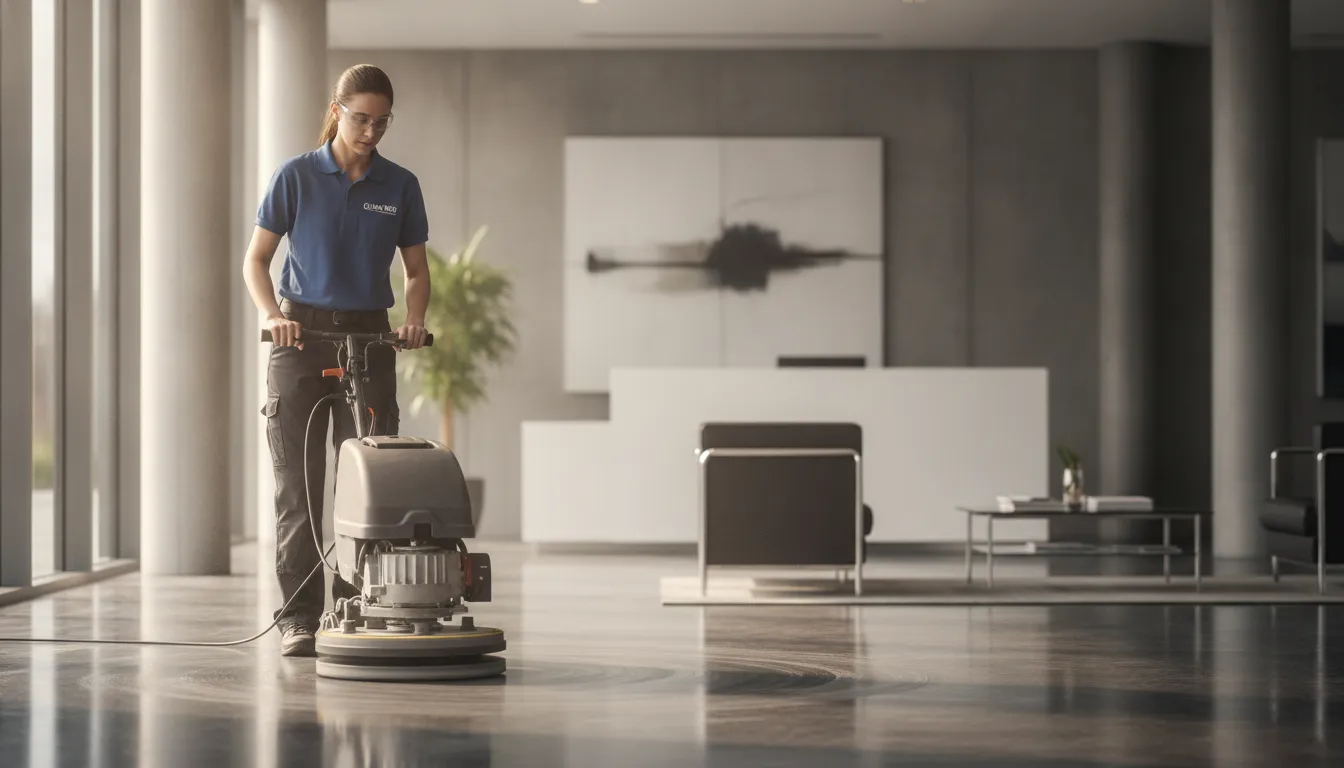
Commercial hard floor cleaning is not one process performed the same way on every surface. A dull VCT hallway, an ESD floor in a server room, and a polished concrete lobby each require a different combination of products, equipment, and maintenance timing. Choosing the wrong method can leave soil behind, damage a protective finish, or create avoidable disruption.
Request a customized commercial hard floor cleaning assessment from Foreman Pro Cleaning.
This guide explains routine cleaning, buffing, stripping, and waxing so facility managers can recognize what their floors need. It also covers VCT, ESD flooring, concrete, and high-traffic commercial environments. The right plan protects the floor system while supporting a clean, professional facility.
What commercial hard floor cleaning includes
Commercial hard floor cleaning includes routine soil removal and deeper procedures designed around the floor material and its protective finish. Daily or frequent service usually removes loose debris, spots, and tracked-in soil before it can scratch or discolor the surface. Periodic service addresses embedded soil, worn traffic lanes, and finish conditions that routine mopping cannot correct.
Routine cleaning protects the surface
Dry soil acts like an abrasive under foot traffic. Entryways and corridors usually collect it faster than low-use rooms. A routine program may combine dust control, spot cleaning, damp mopping, or mechanical scrubbing. The selected chemical and pad must be compatible with the floor and any coating on it. Foreman Pro Cleaning builds these choices into a customized plan instead of treating every hard surface alike.
Restorative work addresses finish failure
When a floor remains dull, discolored, or uneven after cleaning, the issue may be worn finish rather than soil. A professional assessment can determine whether buffing, a scrub and recoat, or full stripping and refinishing is appropriate. This distinction matters because aggressive restoration is unnecessary when a lighter process can recover the appearance.
Cleaning vs. buffing, stripping, and waxing
These services solve different problems. Cleaning removes soil. Buffing or burnishing improves the appearance of a compatible finish. Stripping removes old finish. Waxing, often called refinishing, installs new protective finish after the floor is prepared.
| Service | Primary purpose | Typical use |
|---|---|---|
| Routine cleaning | Remove loose and adhered soil | Ongoing maintenance |
| Buffing or burnishing | Improve gloss and reduce minor marks | Finish is intact but looks dull |
| Scrub and recoat | Remove surface soil and add finish | Finish is worn but still serviceable |
| Strip and refinish | Remove failed finish and rebuild protection | Finish is yellowed, damaged, or uneven |
Buffing is not a substitute for cleaning
Buffing a dirty floor can work contamination into the surface and produce uneven results. The floor should first be cleaned using a compatible process. Buffing also cannot repair deep scratches, damaged tile, moisture problems, or a finish layer that has worn through.
Stripping is a major reset
Full stripping is more disruptive than routine maintenance. It requires careful chemical control, removal of old finish, rinsing or neutralization as appropriate, drying, and application of new finish. The work should be scheduled around facility operations and performed only when the floor system supports it.
When does VCT need stripping and waxing?
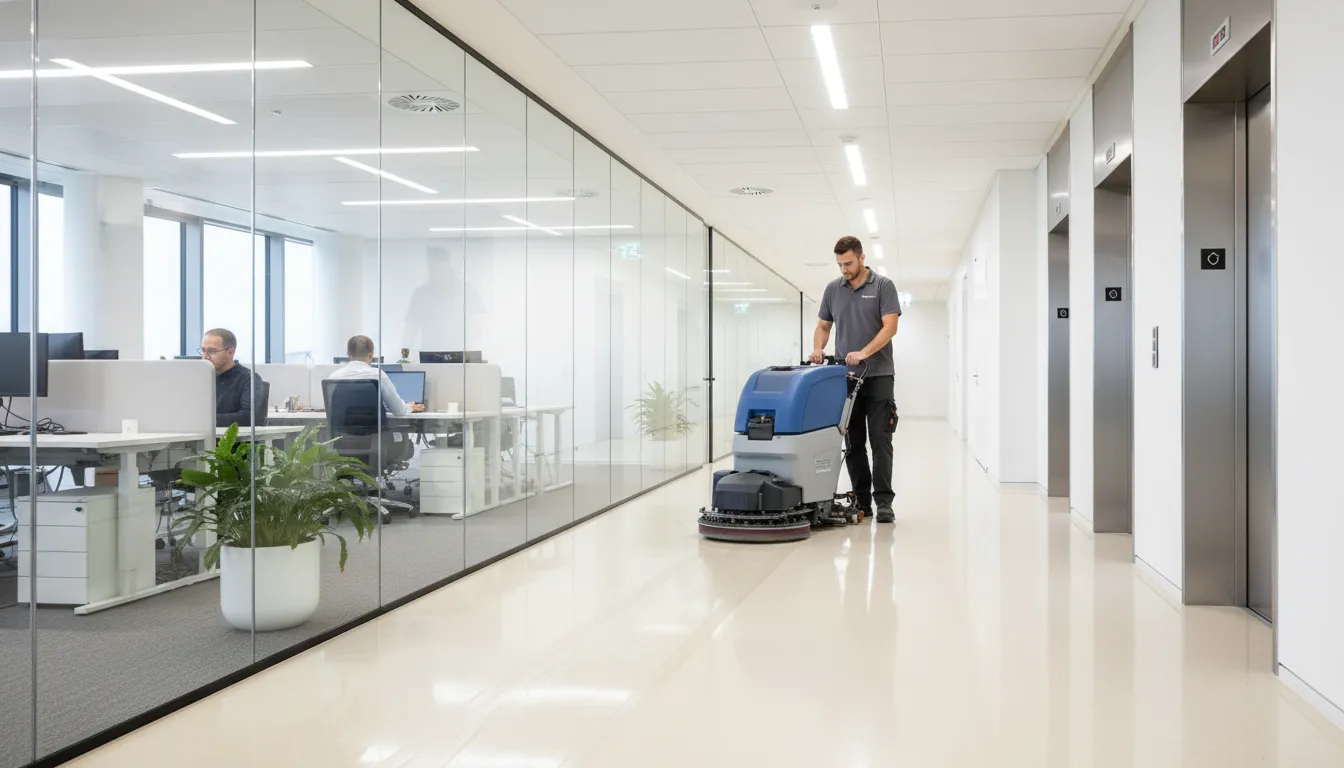
Vinyl composition tile, or VCT, is commonly protected by layers of floor finish. Routine cleaning and periodic buffing can preserve that finish. A scrub and recoat may extend its service life when wear is limited to the upper layers. Full stripping and refinishing becomes appropriate when the existing finish can no longer be restored evenly.
Look beyond gloss alone
Dull traffic lanes do not always mean the entire floor needs stripping. A professional should assess whether soil, scratches, uneven finish, or exposed tile is causing the appearance. Yellowing, widespread finish failure, deeply embedded contamination, and severe inconsistency can indicate that a complete reset is needed.
Use a maintenance cycle instead of waiting for failure
A planned cycle helps protect VCT before wear reaches the tile itself. Entrance matting, frequent dust removal, correct cleaner dilution, and periodic machine care all help. The schedule should reflect traffic, weather, facility hours, and appearance standards rather than a one-size-fits-all calendar.
How is ESD flooring cleaned safely?
Electrostatic dissipative flooring supports sensitive environments such as data centers, server rooms, laboratories, and certain operational spaces. Cleaning choices must preserve the floor system’s intended performance. Products or coatings that are acceptable on ordinary commercial floors may be unsuitable for ESD flooring.
Confirm the floor system before work begins
The provider should identify the flooring and follow manufacturer guidance, site procedures, and any critical-environment requirements. Product compatibility, equipment condition, moisture control, and technician practices all matter. Applying an unapproved finish simply to create shine can interfere with the purpose of the surface.
Control the process in critical environments
Critical environments often require careful scheduling, controlled movement, and attention to nearby equipment. Foreman Pro Cleaning brings proprietary critical-environment training and leadership experience in IT operations and facilities management to this type of work. A customized plan should define methods, access, and verification before service starts.
ESD floor care should begin with the site’s specifications and the flooring manufacturer’s instructions. Before service, the team should confirm approved chemistry, pad type, machine settings, access controls, and any documentation requirements. The work plan should also account for cables, racks, sensitive equipment, and areas where moisture must be tightly controlled.
- Use only products approved for the installed ESD floor system.
- Avoid coatings that can change electrical performance unless specifically authorized.
- Control dust with appropriate equipment and methods.
- Coordinate access so cleaning does not interrupt critical operations.
- Document the agreed process and inspect results after service.
Foreman Pro Cleaning’s critical-environment cleaning services are designed for facilities where contamination control and operational continuity matter. That specialized approach helps facility teams avoid treating a sensitive ESD surface like an ordinary hallway floor.
Talk with Foreman Pro Cleaning about a floor care plan for sensitive or high-traffic spaces.
What does commercial concrete floor care require?
Concrete floors may be polished, sealed, coated, or left relatively porous. Those systems respond differently to water, chemistry, abrasion, and mechanical equipment. A provider should identify the surface before selecting a process.
Polished and sealed concrete need compatible care
Routine soil removal helps reduce abrasion and preserves appearance. Spills should be addressed promptly because oils, dyes, and other contaminants may stain or affect the protective system. An incorrect cleaner can leave residue, reduce gloss, or harm a sealer.
Cleaning cannot fix every concrete problem
Cracks, coating delamination, deep staining, and physical deterioration may require repair or specialized restoration rather than janitorial cleaning. A clear assessment separates cleanable soil from damage and helps the facility avoid paying for a process that cannot solve the underlying issue.
How to plan floor care for high-traffic facilities
High-traffic environments need a plan that responds to where and how soil enters the building. Offices, schools, medical facilities, fitness centers, retail spaces, and public corridors may have different risk and appearance requirements.
- Map the floor systems. Record VCT, concrete, ESD, tile, and other materials, including their known finishes or coatings.
- Identify traffic and soil zones. Prioritize entrances, elevators, corridors, service areas, and spaces exposed to weather.
- Define routine tasks. Match dust control, spot cleaning, mopping, or mechanical scrubbing to each zone.
- Set inspection points. Watch for dullness, residue, scratches, finish loss, and changing safety concerns.
- Schedule periodic maintenance. Plan buffing, scrub and recoat work, or restoration around operating hours.
- Review results. Adjust frequencies when seasons, occupancy, or facility use changes.
Frequency should follow conditions
A busy entrance during wet weather may need attention several times within a service period, while a controlled interior room may require less. Customized cleaning plans allocate effort where it protects the floor and supports the facility most effectively.
Inspection-based scheduling is more useful than waiting for complaints. Facility teams can record finish wear, recurring spill areas, soil at entrances, and changes in traffic. Foreman Pro Cleaning can use those observations during a walkthrough to create a zone-based plan that fits the building’s operating hours and priorities.
Match service timing to facility operations
Floor care can require controlled access and drying time, especially during restorative work. A practical schedule identifies which sections can close, how people will be redirected, and when the floor can safely return to service. For schools, this may mean planning deeper work around breaks. For medical environments, the plan must account for patient flow and facility protocols.
Organizations with demanding environments can review Foreman Pro Cleaning’s school cleaning services and medical office cleaning services for examples of facility-specific planning.
How do you know routine cleaning is not enough?
Routine cleaning may be insufficient when a floor still looks cloudy, streaked, dull, or discolored after the correct process. Persistent traffic lanes, increasingly visible scratches, peeling finish, bare VCT, and uneven gloss are reasons to request an assessment.
Separate residue from worn finish
Residue can sometimes be corrected with improved chemistry, dilution, rinsing, or equipment practices. Worn finish requires a different response. Testing a small area can help identify whether deeper cleaning or finish maintenance will deliver the desired result.
Recognize problems outside the cleaning scope
Loose tiles, cracks, moisture intrusion, failed coatings, and deep damage generally require repair or specialized restoration. A reliable provider should explain these limits rather than promise that an aggressive cleaning service will fix every visible defect.
Choosing a commercial hard floor cleaning partner
Ask prospective providers how they identify floor systems, select compatible products, train technicians, and protect occupied spaces. They should be able to explain the difference between routine and restorative work and recommend the least aggressive effective method.
Questions to ask
- How will you confirm our floor type and finish?
- Which methods and products are appropriate for each area?
- How will service be scheduled around employees, visitors, or sensitive operations?
- What signs will trigger periodic or restorative work?
- How will you document and adjust the maintenance plan?
Foreman Pro Cleaning provides commercial cleaning services, critical-environment cleaning, and hard floor care services across Maryland, Washington D.C., and Virginia. Its customized approach can support ordinary commercial spaces as well as facilities where operational integrity requires meticulous procedures. A walkthrough gives both teams the opportunity to identify floor systems, discuss priorities, and build a practical scope.
Frequently asked questions
How often should commercial hard floors be professionally cleaned?
The right frequency depends on floor material, traffic, weather, operating hours, soil exposure, and appearance standards. A provider should inspect the facility and build a plan by zone instead of assigning one frequency to every floor.
What is the difference between buffing and waxing?
Buffing or burnishing works on an existing compatible finish to improve appearance and reduce minor marks. Waxing or refinishing applies new protective finish after the floor has been properly prepared.
Can every hard floor be stripped and waxed?
No. Stripping and refinishing is suitable only for floor systems designed for that process. ESD flooring, concrete coatings, and other specialized surfaces require compatible methods based on manufacturer and site guidance.
Does a dull floor always need restoration?
No. Dullness may come from soil, residue, incorrect products, scratches, or finish wear. An assessment and small-area test can help determine the least aggressive effective response.
Build the right floor care plan for your facility
A clean, well-maintained floor supports a professional environment and helps protect the flooring investment. Foreman Pro Cleaning can assess your VCT, ESD flooring, concrete, and other hard surfaces, then develop a customized maintenance plan for your facility.
