
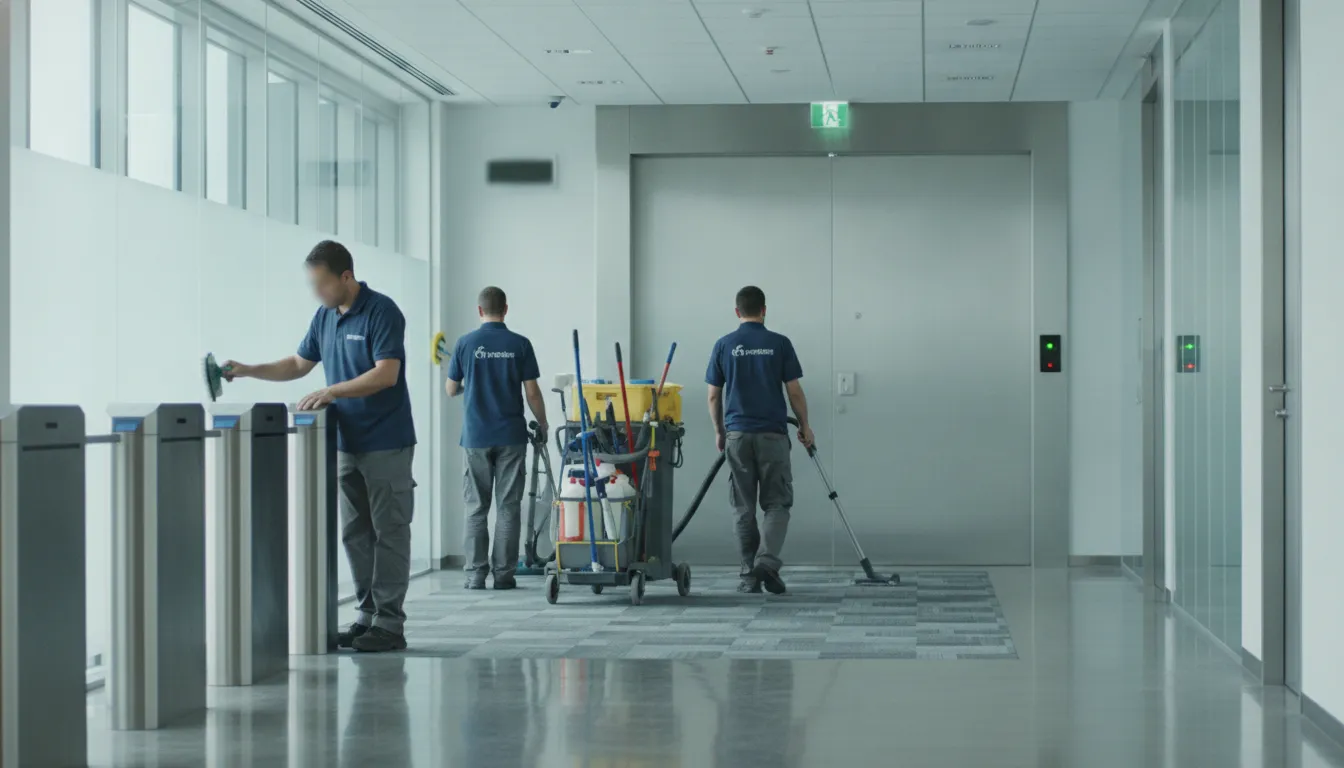
Cleaning a government facility is not simply a matter of maintaining a professional appearance. Sensitive offices, command centers, laboratories, and technical spaces require controlled access, disciplined contamination control, and documentation that supports operational and security requirements. The cleaning partner must understand how microscopic particulates, residue, and process deviations can affect people, infrastructure, and mission continuity.
Secure government facility cleaning combines vetted personnel, contamination control protocols, documented procedures, and environment-specific training to protect sensitive operations while meeting applicable facility requirements.
Foreman Pro Cleaning supports agencies across Maryland, Washington, D.C., and Virginia with structured service plans informed by critical-environment experience. If your facility requires a more controlled approach than conventional janitorial service, request a secure facility cleaning assessment before selecting a provider. The distinction begins with the access controls, technical methods, and accountability built into the work itself.
Request a Secure Facility Cleaning Assessment
How Is Secure Government Facility Cleaning Different from Standard Office Cleaning?
Standard office cleaning generally prioritizes appearance, occupant comfort, and routine hygiene. Secure government facility cleaning must also protect controlled access, sensitive infrastructure, and the operational conditions that support mission-critical work. The distinction is not cosmetic. It is defined by documented procedures, authorized access, controlled movement, and cleaning methods selected for the facility’s risk profile.
Government facilities may include offices alongside command centers, laboratories, server rooms, or other restricted spaces. Each area requires a service plan based on its space classification, equipment sensitivity, occupancy, and applicable security procedures. Federal guidance establishes baseline security expectations for video surveillance and intrusion detection systems in federally owned facilities. Custodial activity must be coordinated with that broader protection framework. GSA’s baseline minimum security standards provide that security context.
How Does Contamination Control Change the Cleaning Standard?
In a conventional office, visible residue and routine surface hygiene may define an acceptable result. In a secure technical environment, microscopic particulates can affect equipment, workflows, and environmental control objectives. Foreman Pro Cleaning uses HEPA-filtered vacuums and microfiber technology to exceed baseline contamination standards, with methods selected to reduce particulate redistribution rather than merely move contaminants between surfaces. Foreman Pro Cleaning’s facility methodology incorporates that distinction.
ISO 14644-1 terminology illustrates why the same method cannot be applied everywhere. ISO Class 5 allows 3,520 particles per cubic meter at 0.5 micrometers. ISO Class 7 allows 352,000, and ISO Class 8 allows 3,520,000, per cleanroom classification guidance and the ISO standard reference. These tenfold differences demonstrate how cleanliness objectives escalate by space type.
Accordingly, secure government facility cleaning is built around contamination control protocols, access coordination, and verifiable service execution. It treats the facility as an integrated operational environment, not as a collection of ordinary rooms.
What Clearance and Vetting Standards Apply to Cleaning Personnel?
Access to a secure government facility is a controlled operational privilege, not an ordinary staffing consideration. Before personnel enter sensitive work areas, the agency and its contractor should establish who may enter, which spaces are accessible, and what credentials are required. In the Maryland, Washington, D.C., and Virginia market, federal agencies commonly require vendors with established security-vetting processes and personnel cleared for sensitive areas. Foreman Pro Cleaning approaches staffing with that expectation as a baseline for secure government facility cleaning.
How Do Background Vetting Tiers Govern Access?
Vetting should correspond to the sensitivity of the assignment. A worker assigned to public areas may not require the same review as one entering restricted operational spaces, server rooms, or classified areas. Government contractor security protocols require rigorous background checks and mandatory reporting for anyone accessing classified information, as described in 12 FAM 0710, which cites Security Executive Agent Directive 3.
Operations leads should therefore require a documented personnel roster, confirmation of approval before assignment, and a process for reporting changes in employment status, access eligibility, or assigned duties. Cleaning schedules should also reflect the authorization boundary. A cleared employee should not be treated as automatically authorized for every room, system, or mission area within a facility.
What Role Does HSPD-12 and PIV Credentialing Play?
HSPD-12 and Personal Identity Verification, or PIV, credentials support identity assurance for federal personnel and eligible contractors. Credentialing does not replace the agency’s local access-control rules. Instead, it gives security personnel a reliable identity credential that can be checked against the individual’s authorization, escort requirements, work order, and approved time window.
A compliant contractor workflow should include credential verification at entry, controlled key and badge handling, immediate reporting of lost credentials, and removal of access when an assignment ends. Supervisors should maintain access records without allowing cleaning documentation to expose sensitive mission details. The objective is clear accountability for every person, entry, and task while preserving operational confidentiality.
Why Do SCI Facilities Require Additional Discipline?
Sensitive Compartmented Information facilities require strict adherence to intelligence-community directives designed to protect intelligence and intelligence-related information, including sources and methods. The Department of State’s security guidance identifies this directive-driven framework for SCI protection. Cleaning personnel must follow the facility security officer’s instructions, remain within approved boundaries, and avoid unscheduled access, photography, personal devices, or unattended materials.
Foreman Pro Cleaning can align its proprietary critical-environment training with agency-specific access procedures, supervision requirements, and contamination-control protocols. That alignment helps facility leaders evaluate not only whether a worker is vetted, but whether the worker is trained to operate responsibly inside the facility’s security architecture.
How Does Secure Government Facility Cleaning Manage Contamination Control?
Contamination control in a sensitive government environment is an operational discipline, not a cosmetic service. Command centers, laboratories, server rooms, and other technical spaces can be affected by microscopic particulates, residue, and biological contaminants that compromise equipment reliability or introduce avoidable risk. NASA’s Technical Facilities Management guidance identifies specialized cleanroom cleaning, certification management, and disposable apparel as essential services for high-sensitivity environments. NASA’s technical facilities guidance provides a relevant model for establishing controlled cleaning practices.
The objective is continuous particulate management. Cleaning personnel must control what is removed, where it is moved, and how tools, apparel, and products are introduced into each zone. A defined sequence reduces cross-contamination between rooms and protects sensitive infrastructure during routine service, maintenance activity, and occupancy changes.
How Are Particulates Removed Without Redistributing Them?
Foreman Pro Cleaning uses HEPA-filtered vacuums and microfiber technology to exceed baseline contamination standards required by secure facilities. Foreman Pro’s critical-environment methodology treats equipment selection as part of the control system. HEPA filtration helps capture fine particulate matter at the point of collection, while microfiber tools support controlled removal from surfaces without relying on casual wiping practices. Technicians should work from cleaner zones toward higher-soil areas, maintain dedicated tools where risk warrants them, and follow controlled routes that prevent reintroducing contaminants into completed spaces.
Which Disinfection Practices Protect Sensitive Operations?
Where a biological or operational risk assessment requires disinfection, technicians apply EPA-registered disinfectants according to the product label, material compatibility requirements, and the facility’s approved procedures. The application method, dwell time, ventilation conditions, and documentation should be defined before work begins. In environments containing electronic systems, laboratory components, or specialized finishes, product selection must account for residue, moisture, and corrosion risks rather than treating every surface identically.
NASA’s guidance also connects contamination control with certification and appropriate disposable apparel, including shoe covers and gloves. Those controls help establish a repeatable boundary between personnel, cleaning materials, and controlled areas. Foreman Pro Cleaning integrates proprietary critical-environment training and contamination control protocols into its service approach, supporting facility-specific procedures instead of applying a generic office routine. Explore Foreman’s critical environment cleaning services for a program aligned with the sensitivity, occupancy, and operational requirements of the site.
How Do Compliance and Documentation Requirements Shape Secure Cleaning?
Compliance in secure government facility cleaning is operational, not merely administrative. A defensible program connects the facility’s security posture, space classification, work instructions, personnel records, and service verification. The result is a documented chain showing what was cleaned, where, by whom, with which controls, and under what access conditions.
GSA establishes baseline minimum security standards for video surveillance and intrusion detection systems in federally owned facilities. Although those controls are security infrastructure rather than custodial procedures, cleaning work must be coordinated around them and must not compromise their operation. The GSA baseline security directive also references the Interagency Security Committee Risk Management Process, which assigns the occupant agency responsibility for identifying and maintaining security equipment.
| Control area | Standard office cleaning | Secure government or sensitive technical space |
|---|---|---|
| Air cleanliness | Routine surface and floor maintenance without a specified ISO particle class. | ISO 14644-1 reference classes may apply: ISO 5 allows no more than 3,520 particles/m3 at 0.5 um, ISO 7 allows 352,000, and ISO 8 allows 3,520,000. Each lower class represents a tenfold reduction in the stated limit. Cleanroom classification data and the ISO 14644-1 standard provide the reference framework. |
| Work planning | Schedules are generally organized around common occupancy patterns and routine task frequency. | Space type, occupancy, equipment sensitivity, and access restrictions shape task frequency. The GSA National Consolidated Services specification requires clear agreement on square footage by space type and supports productivity and task-frequency assessment based on building type and occupants. |
| Records and verification | Completion may be recorded through a basic checklist or supervisor review. | Records should support access control, assigned areas, approved procedures, exceptions, inspection results, corrective actions, and equipment or security-system coordination. GSA’s custodial specification also identifies tools such as the Custodial Square Footage Tool and Custodial Dashboard Web App for consistent service planning. |
Documentation should also distinguish laboratories, server rooms, command centers, and ordinary administrative areas. GSA’s specification requires agreement on cleaned square footage by space type, since classification affects both control method and frequency. In high-sensitivity technical environments, NASA documentation describes cleanroom cleaning, certification management, garment services, and disposable garments as specialized facilities-management functions.
Foreman Pro Cleaning applies this compliance mindset through defined work instructions, contamination control protocols, and service records that can be reviewed by facility stakeholders. The key question for agencies evaluating government building cleaning services is whether the provider produces evidence of controlled execution, not just a claim of completion.
Request a Compliance-Focused Cleaning Assessment
Why Do MD/DC/VA Agencies Choose Foreman Pro Cleaning for Secure Facilities?
Agencies across Maryland, Washington, D.C., and Virginia need more than a conventional custodial vendor when cleaning occurs inside secure facilities. They need a service partner that understands controlled access, sensitive infrastructure, operational continuity, and the consequences of introducing contaminants into environments where security and performance are inseparable. Foreman Pro Cleaning brings that perspective to each engagement through leadership experience spanning IT operations and facilities management.
That combined background helps the team align cleaning activity with the facility’s mission. Work plans can account for restricted zones, equipment sensitivities, approved access procedures, and the distinction between administrative areas and command centers, laboratories, server rooms, or other critical spaces. Agencies evaluating IT operations-based cleaning methodology can see how infrastructure awareness supports a more disciplined service model.
How Does Proprietary Training Support Secure Facility Work?
Foreman Pro Cleaning integrates proprietary critical environment training and contamination control protocols into its secure facility cleaning methodology. This training is designed to reinforce controlled movement, appropriate equipment handling, sequence discipline, and continuous particulate management rather than relying on generalized janitorial routines. The approach is consistent with the specialized expectations described in certified critical environment cleaning, where procedural consistency and documented competence matter.
Foreman Pro also applies HEPA-filtered vacuums and microfiber technology where the environment requires tighter particulate control. In command centers and laboratory settings, continuous particulate management helps reduce the risk of equipment contamination and operational disruption. Agencies can review the rationale for specialized command center cleaning services when determining whether a standard service specification is adequate.
Why Do Vetting and Regional Experience Matter?
Federal agencies in the DC, Maryland, and Virginia region require vendors with established security vetting and personnel cleared or otherwise appropriately vetted for access to sensitive areas. Foreman Pro Cleaning treats access controls and personnel suitability as foundational for secure government facility cleaning, not administrative details added after contract award. This supports a more dependable relationship between facility leadership, security stakeholders, and the cleaning team.
For agencies managing cleanrooms or similarly controlled environments, Foreman Pro can also align facility-specific procedures with ISO 14644-1 compliant cleaning standards. The result is a regional partner capable of combining vetted personnel, technical cleaning discipline, and facilities-management accountability in one service framework.
Schedule a Secure Facility Cleaning Consultation
Which Questions Do Agencies Ask About Secure Cleaning?
What sets secure government facility cleaning apart from standard office cleaning?
It combines controlled access, documented work procedures, contamination control, and task verification. Cleaning plans are adapted to the facility’s security zones, operational schedule, materials, and equipment. Sensitive areas may require HEPA-filtered vacuums, microfiber technology, restricted movement, and coordination with designated facility personnel rather than a routine office-service model.
What qualifications should a secure government facility cleaning provider have?
Look for a provider with documented personnel-vetting procedures, training for controlled environments, clear access protocols, and experience maintaining compliance records. The provider should also demonstrate supervision, incident escalation procedures, and the ability to align its work with agency requirements, facility classifications, and applicable security directives.
What types of facilities require specialized government cleaning services?
These services may support offices, command centers, laboratories, data centers, server rooms, and network rooms where contaminants or unauthorized access could affect operations. The cleaning scope should reflect the facility’s mission, risk profile, and environmental controls.
How are sensitive environments protected during cleaning?
A qualified team uses contamination control protocols, zone-specific procedures, approved materials, and continuous coordination with facility stakeholders. Foreman Pro Cleaning applies critical-environment training and methods designed to manage microscopic particulates without disrupting sensitive systems, occupants, or security operations.
Why is documentation important for government facility cleaning?
Documentation creates an auditable record of assigned tasks, completion times, personnel, exceptions, inspections, and corrective actions. It helps facility managers verify that work was performed as specified, identify recurring risks, support accountability, and demonstrate alignment with contract requirements and agency oversight.
How Do You Schedule a Secure Facility Cleaning Consultation?
A consultation can help your agency align clearance expectations, contamination control protocols, and documentation requirements with the facility’s operational needs. Foreman Pro Cleaning brings a formal, critical-environment approach to sensitive government spaces across Maryland, Washington, D.C., and Virginia. To request a secure government facility cleaning consultation, contact Foreman Pro Cleaning through the secure facility consultation form and speak with the team about your facility, access requirements, and service objectives.
