
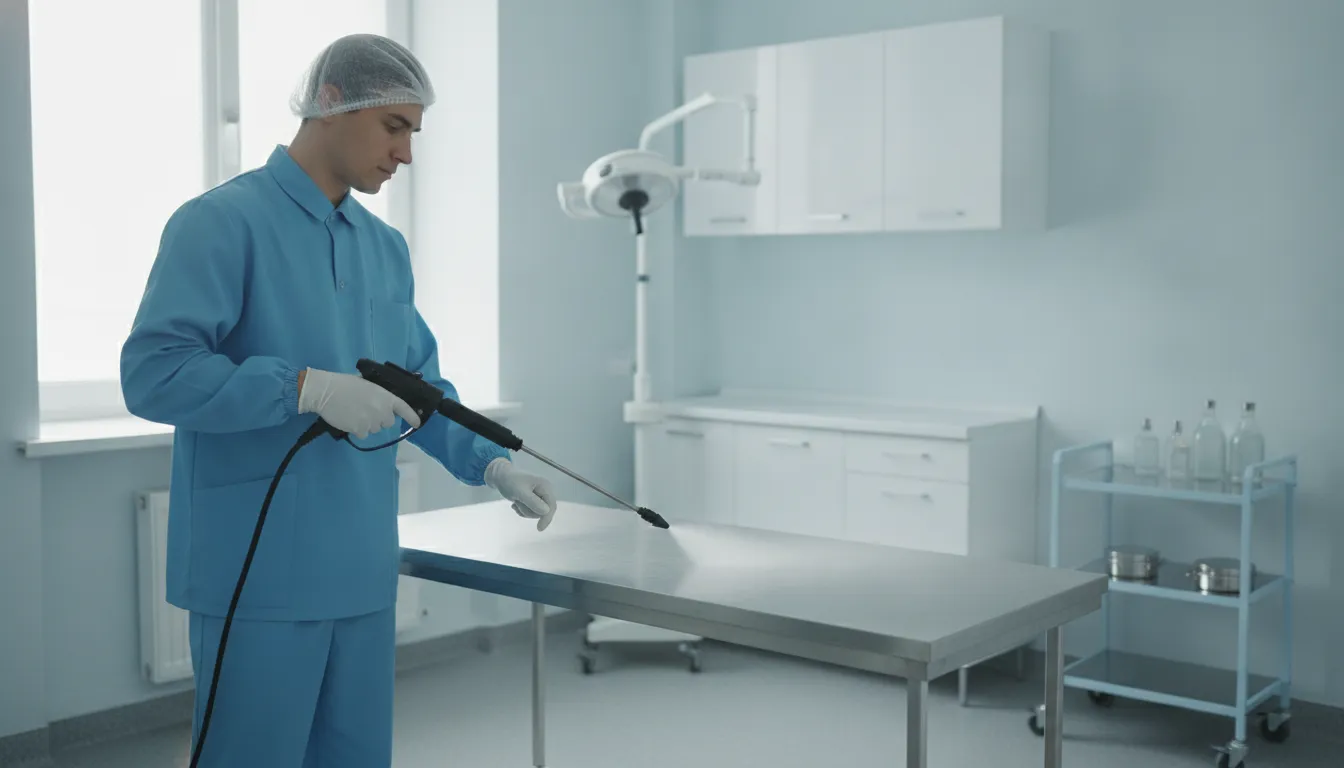
A clinic cleaning quote should reflect more than square footage. Patient volume, treatment areas, operating hours, high-touch surfaces, waste-handling procedures, and required documentation all influence the level of service a medical office needs. A proposal that ignores these variables in favor of a flat rate invites gaps that surface only after service begins.
To get a quote for clinic cleaning, provide your facility details, schedule a site walkthrough. And request a written plan that identifies cleaning frequencies, disinfection protocols, products, staffing, and service boundaries. Foreman Pro Cleaning uses that assessment to prepare a tailored scope for clinics across Maryland, Washington D.C., and Virginia.
The quality of the assessment determines the quality of the proposal. Before comparing prices, examine what each quote includes, how it addresses specialized clinical spaces, and whether the promised service can support your compliance and patient-care objectives.
Foreman Pro Cleaning develops customized cleaning plans for clinics and medical offices throughout Maryland, Washington D.C., and Virginia. Its leadership experience in IT operations and facilities management supports a disciplined approach to contamination control, patient-facing spaces, and operational access. The sections below walk through what a professionally prepared quote should contain and the standards a compliant partner should be prepared to meet.
Get a free clinic cleaning quote from Foreman Pro Cleaning today
What Does a Clinic Cleaning Quote Actually Include?
A clinic cleaning quote should define more than a visit schedule and a square-foot price. It should identify the surfaces, rooms, procedures, products, documentation, and waste streams included in the service. That distinction matters because a general office scope may be adequate for administrative areas but incomplete for exam rooms, treatment spaces, and other patient-care environments.
Use the following comparison when reviewing proposals. A medical office cleaning checklist can help facility leaders confirm whether the written scope addresses the operational details that affect patient safety and service consistency.
| Scope item | Standard office quote | Compliant clinic quote |
|---|---|---|
| High-touch surface disinfection | Routine wiping of common touchpoints such as desks, door hardware, and breakroom surfaces. | Defined cleaning and application of EPA-registered disinfectants on clinical touchpoints, with methods matched to the surface and facility requirements. |
| Floor care | Scheduled vacuuming, mopping, and periodic hard-floor maintenance in common areas. | Room-specific floor procedures for waiting areas, corridors, exam rooms, and treatment spaces, including controls for cross-contamination. |
| Restroom sanitation | General restroom cleaning and replenishment of consumables. | Documented sanitation of patient and staff restrooms, with attention to high-touch fixtures, hand-hygiene areas, and inspection frequency. |
| Medical or biohazard waste handling | Removal of ordinary office refuse and recycling. | Clearly defined limits for regulated waste, sharps, and contaminated materials, including who handles each stream and how containers are managed under applicable procedures. |
| Exam-room turnaround | Usually excluded or treated as ordinary room cleaning between scheduled visits. | Specified sequence, touchpoints, dwell-time requirements, supplies, and escalation procedures for rooms used by patients. |
| Regulatory compliance documentation | Basic service checklist or invoice confirmation. | Defined logs, quality checks, product information, training records, and scope documentation suitable for operational review. |
Price should be evaluated against this scope rather than compared as a standalone number. Routine medical office cleaning is commonly discussed in the range of approximately $0.10 to $0.35 per square foot. While conventional commercial office work may fall near $0.10 to $0.20 per square foot. These are broad planning ranges, not a substitute for a site assessment. Room mix, patient volume, specialty procedures, access restrictions, service frequency, and waste requirements can materially change the final quote.
Foreman Pro Cleaning uses a walkthrough and operating discussion to separate administrative areas from patient-care spaces and build a service plan around the clinic’s actual requirements. A credible proposal should make those assumptions visible, so the facility can compare coverage, compliance support, and accountability alongside price.
What Information Should You Prepare Before Requesting a Quote?
A tailored clinic cleaning proposal depends on accurate information about the facility, its occupants, and its operating constraints. Before requesting a quote, assemble the following details so the provider can evaluate the environment rather than rely on generic commercial assumptions. This preparation also makes the site walkthrough more productive. Foreman Pro Cleaning recommends a walkthrough because it allows the cleaning partner to assess the facility’s specific requirements, size, and service scope directly. Review this medical office cleaning checklist as a practical starting point.
- Document the square footage and layout. Provide the approximate total square footage, floor plans if available, and a breakdown of reception areas, corridors, waiting rooms, restrooms, administrative offices, and clinical space. Note separate buildings, multiple floors, controlled-access zones, elevators, and surfaces that require specialized floor care. A clear layout helps the provider estimate labor, equipment, travel paths, and material requirements.
- Describe patient and occupant volume. Share average daily patient counts, staff headcount, visitor volume, and the busiest days or time periods. Include seasonal fluctuations or appointment patterns that affect traffic. This information helps determine where continuous particulate management and more frequent high-touch disinfection may be appropriate.
- Identify specialty areas and clinical activities. List exam rooms, procedure rooms, treatment areas, laboratories, imaging spaces, pharmacies, and any areas where blood or other potentially infectious materials may be present. Clarify whether the site includes isolation capabilities, sensitive equipment, or surfaces that require defined cleaning and disinfectant procedures. Scope documents should account for high-touch surface disinfection, floor care, restroom sanitation, and waste removal, as outlined in Foreman Pro’s checklist guidance.
- State operating hours and access requirements. Provide normal business hours, patient intake windows, shift changes, and preferred service times. Explain after-hours access, badges, keys, alarm procedures, loading access, parking limitations, and escort requirements. These operational details can materially affect scheduling and the written proposal.
- Share the current cleaning schedule and service history. Include the present task frequency, assigned responsibilities, recurring deficiencies, and any areas that are routinely missed. Complaint logs, inspection records, corrective-action notes, and recent audit findings can reveal where the proposal needs additional controls instead of simply reproducing the existing schedule.
- Provide applicable standards and pain points. Identify accreditation expectations, regulatory requirements, infection-control policies, and internal documentation standards. Explain the problems you want resolved, such as inconsistent restroom sanitation, incomplete high-touch disinfection, supply gaps, or inadequate after-hours coverage. Specific pain points enable a measurable scope of work and a more accountable quote.
When facility managers provide this information in advance, the walkthrough can focus on verification and risk-sensitive details. The result is a quote aligned with actual clinic operations in Maryland, Washington, D.C., or Virginia, rather than an estimate based only on square footage.
Why Is Specialized Clinic Cleaning Different From Standard Commercial Cleaning?
A clinic is not simply an office with more frequent housekeeping. Patient care introduces biological hazards, high-touch contact points, clinical equipment, and workflows that require deliberate contamination control protocols. The cleaning plan must support patient safety and operational continuity while respecting treatment areas, staff activity, and the facility’s infection-prevention requirements.
Environmental surfaces can serve as reservoirs for pathogens, with transfer to patients occurring largely through hand contact. The CDC identifies appropriate environmental cleaning and disinfection as fundamental to reducing the contribution of those surfaces to healthcare-associated infections. CDC environmental services guidance therefore informs more than appearance standards. It shapes how a qualified team sequences work, selects products, and documents completion.
How Do Disinfectant Requirements Change the Scope?
Clinic cleaning requires the application of EPA-registered disinfectants selected for the facility’s clinical risks and the pathogens relevant to its environment. Product selection must be paired with the labeled contact time, appropriate dilution, surface compatibility, and a defined application method. A product that is suitable for one area may not be appropriate for every material or clinical use case. The EPA’s list of selected registered disinfectants provides a reliable starting point for evaluating products, while the facility’s infection-prevention program determines how they are used.
That scope extends to high-touch surfaces such as exam-room contact points, work surfaces, door hardware, and restroom fixtures. Cleaning personnel must avoid moving contaminants from one zone to another by using controlled sequences, dedicated or appropriately managed equipment, fresh microfiber materials, and documented procedures. Foreman Pro Cleaning develops service plans around these operational details rather than treating every room as an interchangeable office space. Its professional clinic cleaning services guide provides additional context for healthcare environments.
Why Does the Spaulding Classification Matter?
The Spaulding classification helps determine the level of processing required by categorizing medical surfaces and instruments as critical. Semicritical, or noncritical according to their potential to transmit infection if contaminated. The CDC retains this framework in its environmental services guidance. For a cleaning partner, the classification reinforces an essential boundary: routine environmental cleaning is not a substitute for clinical instrument reprocessing. It does, however, help the facility define which environmental surfaces require routine cleaning, which require disinfection, and which must remain under specialized clinical protocols.
OSHA’s Bloodborne Pathogens Standard also establishes housekeeping expectations for areas where occupational exposure may occur. A compliant program addresses regulated waste, contaminated materials, protective practices, exposure-response procedures, and employee training. These requirements reduce cross-contamination risk and help protect patients, clinicians, and environmental-services staff.
What Disinfection and Regulatory Standards Should a Clinic Cleaning Partner Meet?
A compliant clinic cleaning partner should demonstrate more than a general commercial cleaning checklist. The provider should translate infection-control guidance into documented procedures for patient areas, staff spaces, restrooms, treatment rooms, laboratories, and any procedure-capable environment. The scope should identify which surfaces receive routine cleaning, which require disinfection, which products are approved, and how completion is verified.
The CDC identifies environmental cleaning and disinfection as fundamental to reducing the potential contribution of environmental surfaces to healthcare-associated infections. That expectation should be reflected in written protocols for high-touch surfaces, including examination tables, door hardware, counters, light switches, and other areas frequently contacted by staff or patients. The CDC also explains that microorganisms can transfer from contaminated environmental surfaces primarily through hand contact, making methodical surface management central to contamination control.
How Should Disinfectants Be Selected?
A clinic cleaning program should use EPA-registered disinfectants whose labeled claims and contact times are appropriate for the pathogens and surfaces present in that clinical environment. A qualified partner should be able to provide product names, registration information, safety data, dilution requirements, required wet-contact time, and application procedures. Product selection should account for the clinical setting rather than rely on one universal chemical for every room. For example, areas with elevated concern about spore-forming organisms require a product with the relevant EPA efficacy claim.
Foreman Pro Cleaning should also be evaluated on whether its procedures prevent cross-contamination during service. That includes separating clean and soiled materials, changing microfiber materials between zones, sequencing work from cleaner areas toward more contaminated areas, and documenting exceptions. Facility managers can review specialized clinic cleaning protocols when assessing whether a proposed scope addresses these controls.
Which Safety Standards Apply to Housekeeping Work?
OSHA’s Bloodborne Pathogens standard, 29 CFR 1910.1030, applies requirements relevant to employees who may experience occupational exposure, including housekeeping personnel assigned to regulated healthcare environments. A responsible partner should explain exposure-control procedures, employee training, personal protective equipment, regulated-waste handling, sharps awareness, and incident-response steps. The written plan should distinguish routine environmental service from the handling of potentially contaminated materials, with clear escalation procedures for spills or sharps discoveries.
For laboratory or critical-adjacent spaces, the cleaning plan should account for the facility’s controlled-environment requirements and applicable ISO 14644-1 classification objectives rather than introduce unnecessary particulates. In procedure-capable areas, the partner should also align room turnover, surface preparation, and contamination-control practices with the clinic’s applicable AORN guidance. Ask for training records, product documentation, completed service logs, and a site-specific quality review process before accepting a quote.
How Do You Get a Quote for Clinic Cleaning in MD, DC, or VA?
Facility managers should expect a clinic cleaning quote to reflect the actual environment, operational schedule, patient traffic, and contamination-control requirements of the site. A generic rate rarely captures the distinctions between reception areas, examination rooms, treatment spaces, staff areas, restrooms, and any specialized clinical zones. Foreman Pro Cleaning uses a consultative process so the proposed scope is practical, measurable, and aligned with the facility’s priorities across Maryland, Washington D.C., and Virginia.
- Reach out with the essential facility information. Begin through the Foreman Pro Cleaning contact page and identify the facility location, type of clinic, approximate square footage, operating hours, patient volume, and preferred service window. Include any special requirements, such as after-hours access, treatment areas, regulated waste procedures, floor-care needs, or heightened disinfection protocols. This initial information allows the team to prepare for a productive discussion rather than applying a cookie-cutter assumption.
- Schedule a facility walkthrough. A site walkthrough gives the cleaning professional an opportunity to observe the layout, traffic patterns, surface materials, high-touch points, storage constraints, access procedures, and areas requiring specialized attention. Foreman Pro Cleaning’s medical-office guidance recommends a walkthrough because it supports an accurate assessment of the environment, facility size, and service scope. Review the medical office cleaning checklist to identify topics worth discussing before the visit. The walkthrough also creates space for facility leaders to explain workflow concerns that may not be apparent from floor plans or square footage alone.
- Review the tailored cleaning assessment. Following the walkthrough, Foreman Pro Cleaning translates observed conditions and operational requirements into a defined service plan. The assessment can identify appropriate frequencies, task sequences, surface-care requirements, restroom and waste-removal expectations, and coordination points with clinic staff. EPA-registered disinfectant selection should correspond to the pathogens and surfaces relevant to the facility, while procedures should support consistent contamination control. The result is a scope that is specific enough for responsible evaluation and ongoing quality verification.
- Receive and evaluate the written quote. The final written quote should make the proposed services, schedule, assumptions, exclusions, and points of contact clear. Foreman Pro Cleaning’s leadership brings more than 20 years of experience in IT operations and facilities management. A combination that informs disciplined planning for environments where continuity, documentation, and operational integrity matter. Compare the written scope against your clinic’s requirements, then clarify any service frequency, access, escalation, or documentation questions before authorization.
This process makes it easier to get a quote for clinic cleaning that reflects the facility you actually operate, not an abstract square-footage calculation. It also establishes a clear foundation for service delivery and accountability from the first assessment onward.
What Questions Should You Compare Across Clinic Cleaning Quotes?
A written quote should make a provider’s operating model visible, not merely list a price. Compare whether each proposal accounts for patient-facing areas, treatment rooms, staff spaces, restrooms, waste streams, access restrictions, and the level of documentation your clinic requires. A low figure can become misleading when essential tasks, supervision, or response coverage are left undefined.
Use the following questions to evaluate proposals serving clinics in Maryland, Washington, D.C., and Virginia:
- How are cleaning staff trained and supervised? Ask whether personnel receive healthcare-environment training and whether the assigned team includes recognized credentials or programs such as Certified Environmental Technician (CET) or Certified Vulnerable Infection-control (CVI) training. Where applicable. Confirm who performs quality inspections and how deficiencies are corrected.
- Which EPA-registered disinfectants will be used? The proposal should identify product categories, contact-time procedures, and the pathogens addressed in your environment. EPA-registered products must be selected for facility-relevant risks, rather than applied generically. Review the EPA guidance on products effective against C. difficile spores when that risk is relevant.
- How does the scope address bloodborne-pathogen exposure? Ask how housekeeping procedures, personal protective equipment, waste handling, spill response, and employee training align with OSHA 1910.1030. The answer should be specific to clinical operations, not a generic statement about office cleaning.
- What contamination-control records will we receive? Compare inspection logs, task checklists, disinfectant records, incident documentation, training records, and escalation procedures. Documentation should allow a facility manager to verify that the contracted scope was performed and to identify recurring gaps.
- What happens when the assigned cleaner is unavailable? Require a clear backup staffing plan, supervisory contact, urgent-response process, and expected response time for spills or missed service. Ask whether after-hours access, restricted rooms, and schedule changes are reflected in the written scope. The commercial cleaning RFP questions resource provides a useful framework for comparing vendor answers.
Also ask what assumptions the quote makes about your facility. Does the price include specialized floor care, periodic detail work, consumable handling, or after-hours access? Are treatment rooms, laboratories, procedure areas, and administrative offices priced under the same service frequency? These details should be stated in the proposal rather than inferred from a broad phrase such as comprehensive cleaning. Transparency about unique operational needs is essential to an accurate quote, as outlined in the commercial cleaning RFP questions guidance.
Foreman Pro Cleaning should be evaluated on the same measurable criteria as every other proposal: defined tasks. Trained personnel, documented controls, responsive supervision, and a scope tailored to the clinic’s actual operations. Transparent requirements produce a more useful quote and reduce the risk of discovering excluded services after work begins.
Ready to compare compliant clinic cleaning quotes? Talk to Foreman Pro Cleaning.
How Often Should Your Clinic Be Professionally Cleaned?
Clinic cleaning frequency should reflect how patients, staff, equipment, and materials move through the facility. A single schedule rarely serves every room effectively. High-traffic areas generally require daily professional cleaning. While lower-traffic administrative spaces may be serviced two or three times per week when that schedule aligns with the facility’s risk profile and operating requirements. Patient volume, hours of operation, specialty services, and the type of clinical work performed should all inform the final plan.
Waiting areas and reception zones typically need service every day because they receive continuous contact from patients, visitors, and staff. The scope should address door hardware, chair arms, counters, check-in surfaces, touchscreens, and other high-touch points, along with floors and waste receptacles. Environmental surfaces can serve as reservoirs for potential pathogens, with transfer to patients occurring largely through hand contact, according to the CDC guidance on environmental services. That makes consistent cleaning and disinfection more important than relying on occasional deep-cleaning visits.
Exam rooms usually warrant daily service, with additional attention between patient encounters when the clinical activity or contamination risk requires it. A professional team should follow the clinic’s room turnover and contamination-control protocols, not simply clean on a fixed clock. Treatment rooms, procedure rooms, laboratories, and spaces handling bodily fluids may require more frequent service. Defined disinfection steps, or carefully timed cleaning when patients and clinical staff are not present. EPA-registered disinfectants should be selected for pathogens relevant to the facility and applied according to the product label, including required contact time. See this clinic cleaning requirements guide for additional planning considerations.
How Does Frequency Affect a Clinic Cleaning Quote?
Service frequency directly changes the labor, staffing, supply, and scheduling assumptions behind a quote. A request for a weekly visit may not represent the actual scope if the clinic needs daily high-touch disinfection, routine restroom sanitation, waste removal, and floor care. Conversely, a low-traffic records area may not need the same schedule as a busy waiting room. Separating areas by traffic and clinical function helps prevent both under-scoping and paying for unnecessary service.
When you get a quote for clinic cleaning from Foreman Pro Cleaning, provide patient volume, operating hours, room types, procedure schedules, and any after-hours access limitations. A site walkthrough supports an accurate assessment of the facility’s size and service requirements, as outlined in the medical office cleaning checklist. The resulting plan can specify daily, two- to three-times-weekly, between-appointment, and periodic services across Maryland, Washington D.C. And Virginia, giving your team a clearer basis for comparing quotes and maintaining a reliable clinical environment.
Get a tailored clinic cleaning quote from Foreman Pro Cleaning before you decide
Frequently Asked Questions
How much does medical office cleaning cost?
Pricing depends on square footage, patient volume, treatment areas, service frequency, floor surfaces, waste-handling requirements, and access hours. A responsible quote separates routine environmental services from specialized disinfection or periodic floor care. Foreman Pro Cleaning confirms these variables during a site walkthrough rather than applying a generic rate.
What should be included in a clinic cleaning quote?
The written scope should identify high-touch surface disinfection, floor care, restroom sanitation, waste removal, service frequency, assigned responsibilities, and any specialty areas. It should also state which EPA-registered disinfectants and documentation practices apply to the facility. This level of detail makes competing scopes easier to evaluate and reduces ambiguity after service begins.
How do I get a professional quote for cleaning services?
Begin by providing the facility location, approximate size, operating hours, patient volume, clinical specialties, access constraints, and required service frequency. The provider should then complete a site walkthrough and translate the findings into a written plan. Foreman Pro Cleaning serves Maryland, Washington D.C., and Virginia with assessments tailored to the clinic’s operational requirements.
How often should medical offices be professionally cleaned?
Frequency should reflect patient volume, traffic patterns, treatment activities, and the risk profile of each area. High-traffic spaces generally require daily professional cleaning, while lower-traffic areas may follow a different schedule established through the assessment. Your plan should also define response procedures for spills, contamination events, and changes in clinic operations.
Get a Tailored Clinic Cleaning Quote From Foreman Pro
Your clinic deserves more than a one-size-fits-all cleaning schedule. Foreman Pro Cleaning builds every plan around a facility walkthrough, your patient volume, and the regulatory standards that govern medical environments across Maryland, Washington D.C., and Virginia.
Request a clinic cleaning quote from Foreman Pro Cleaning today
Tell us about your facility, and our team will schedule an assessment and prepare a written quote built around your specific disinfection and compliance requirements.
